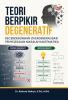
TEORI BERPIKIR DEGENERATIF: Kecenderungan Overgeneralisasi Penyelesaian Masalah Matematika
Kata Kunci:
TEORI BERPIKIR, MATEMATIKASinopsis
Dalam dunia pendidikan matematika, kesalahan siswa sering kali dianggap sebagai akibat dari kurangnya latihan atau ketidaktelitian semata. Namun, apa yang terjadi jika kesalahan tersebut sebenarnya berpola dan berakar dari cara berpikir yang keliru namun sistematis?
Buku "Teori Berpikir Degeneratif" hadir mengupas tuntas fenomena kognitif di mana seseorang cenderung melakukan overgeneralisasi—menerapkan sebuah konsep, rumus, atau strategi matematika yang valid pada satu situasi ke situasi lain yang sebenarnya sama sekali tidak tepat. Alih-alih menghasilkan solusi, pola pikir deduktif yang dipaksakan ini justru mengalami kemunduran fungsi atau degenarasi, yang menjebak pembelajar dalam kekeliruan yang berulang.
Bab
-
KATA PENGANTAR
-
DAFTAR ISI
-
Bab 01. BERPIKIR MATEMATIS
-
Bab 02. KARAKTERISTIK BERPIKIR MATEMATIS
-
Bab 03. PENGERTIAN BERPIKIR GENERATIF
-
Bab 04. KARAKTERISTIK BERPIKIR GENERATIF
-
Bab 05. BERPIKIR DEGENERATIF
-
Bab 07. SEGI EMPAT
-
Bab 08. DEFINISI ANALITIK DAN DEFINISI GENETIK
-
DAFTAR PUSTAKA
-
PROFIL PENULIS
Unduhan
Referensi
Alexander, D. C., & Koeberlein, G. M. (2020). Elementary Geometry for College Students. In Cengage Learning, Inc. Unless.
Anggito, A., & Setiawan, J. (2018). Metodologi Penelitian Kualitatif. CV. Jejak Publisher.
Ashlock, R. B. (2006). Error patterns in computation : using error patterns to improve instruction (9th ed.). Pearson Education.
Axworthy, A. (2021). Motion and Genetic Definitions in the Sixteenth-Century Euclidean Tradition. Max Planck Institute for the History of Science.
Boyd, Cummins, Malloy, Carter, & Flores. (2008). California geometry: Concept, skills, and problem solving. http://www.ias.ac.in/currsci/may252004/1355.pdf
Brown J., Skow K., & the I. C. (2016). Mathematics: Identifying and addressing student errors. Nature and Dirstribution of Variables, 81–100.
Cai, J., & Hwang, S. (2002). Generalized and generative thinking in US and Chinese students ’ mathematical problem solving and problem posing. Journal of Mathematical Behavior, 21, 401–421. https://doi.org/10.1016/S0732-3123(02)00142-6
Clarke, V., & Braun, V. (2013). Successful Qualitative Research a Practical Guide for Beginners (First Publ). SAGE Publications Ltd.
Creswell, J. W. (2012). Educational research: Planning, conducting, and evaluating quantitative and qualitative research. In Educational Research (Vol. 4). https://doi.org/10.1017/CBO9781107415324.004
Dai, D. Y. S. R. J. (2004). Motivation, Emotion, and Cognition: Integrative Perspective on Intellectual Functioning and Development. In Motivation, Emotion, and Cognition: Integrative Perspectives on Intellectual Functioning and Development. Lawrence Erlbaum Asociates. https://doi.org/10.4324/9781410610515
Dreyfus, T. (2002). Advanced Mathematical Thinking Processes. Advanced Mathematical Thinking, 25–41. https://doi.org/10.1007/0-306-47203-1_2
Ellis, A. B. (2007a). A taxonomy for categorizing generalizations: Generalizing actions and reflection generalizations. In The Journal of the Learning Sciences (Vol. 16, Issue 2). https://doi.org/10.1080/1050840070 1193705
Ellis, A. B. (2007b). The Influence of Reasoning with Emergent Quantities on Students’ Generalizations. Cognition and Intruction, 25(4), 439–478.
Ellis, A., Tillema, E., Lockwood, E., & Moore, K. (2017). Generalization across Domains The Relating-Forming-Extending Generalization Framework. Proceedings of the 39th Annual Meeting of the North American Chapter of the International Group for the Psychology of Mathematics Education., 677–684.
Ennis, R. H. (1996). Critical Thinking Dispositions: Their Nature and Assessability. Informal Logic, 18(2), 165–182. https://doi.org/10.22329/il.v18i2.2378
Esteley, C. B., Villarreal, M. E., & Alagia, H. R. (2010). The Overgeneralization of Linear Models among University Students’ Mathematical Productions: A Long-Term Study. Mathematical Thinking and Learning, 12(1), 86–108. https://doi.org/10.1080/10986060903465988
F.C Bartlett. (1932). Remembering: A Study in Experimental and Social Psychology. Cambridge University Press. http://pubman.mpdl.mpg.de/pubman/item/escidoc:2273030:5/component/escidoc:2309291/Bartlett_1932_Remembering.pdf
Felder, R. M., & Brent, R. (2005). Understanding Student Differences. Journal of Engineering Education, 94 (1)(January), 57–72. https://doi.org/10.4135/9781506342733.n2
Fiorella, L., & Mayer, R. E. (2015). Learning as a Generative Activity: Eight Learning Strategies That Promote Undestanding. In Paper Knowledge. Toward a Media History of Documents (Vol. 7, Issue 2). Cambridge University Press.
Grabowski, B. L. (2004). Generative learning contributions to the design of instruction and learning. Handbook of Research on Educational Communications and Technology, December, 719–743.
Haryoko, S., Bahartiar, & Arwadi, F. (2020). Analisis Data Penelitian Kualitatif (Konsep,Teknik, & Prosedur Analisis). Badan Penerbit Universitas Negeri Makassar.
Katona, G. (1943). Organizing and Memorizing. Columbia University Press. https://doi.org/10.1080/00221309.19 43.10545204
Katz, L. G. (1993). Dispositions as Dispositions as Educational Goals. ERIC Digest. ERIC Clearinghouse on Elementary and Early Childhood Education, 1–5.
Kilpatrick, J., Swafford, J., & Bradford, F. (2001). Adding It Up: Helping Children Learn Mathematics. DC: National Academy Press. ftp://129.132.148.131/EMIS/journals/ZDM/zdm026r1.pdf
Lannin, J. K., Barker, D. D., & Townsend, B. E. (2006). Algebraic generalisation strategies: Factors influencing student strategy selection. Mathematics Education Research Journal, 18(3), 3–28. https://doi.org/10.1007/BF03 217440
Low, J., & Hollis, S. (2003). The eyes have it: Development of children’s generative thinking. International Journal of Behavioral Development, 27(2), 97–108. https://doi.org/10.1080/0165025024400047
Mason, J., Burton, L., & Stacey, K. (2010). Thinking Mathematically (Second Ed). Pearson Education Limited.
Mega, T. B., Endah, B. R., & Sugi, H. (2017). Students abstraction in re-cognizing, building with and constructing a quadrilateral. Educational Research and Reviews, 12(7), 394–402. https://doi.org/10.5897/err2016.2977
Moore, K. D., &, & Hansen, J. (2012). Effective Strategies for Teaching in K-8 Classrooms. Chapter 2 Teaching Diverse Students. In SAGE Publications (CA). https://doi.org/10.1207/s15327892mcp0202_6
Mushoriwa, T. D., Sibanda, J., & Nkambule, H. Z. (2010). Testing Generative Thinking among Swazi Children. EDUCARE: International Journal for Educational Studies, Testing, 2(2), 197–210. https://doi.org/10.4314/njgc.v1 4i1.47641
Osborne, R., & Wittrock, M. (1985). The generative learning model and its implications for science education. In Studies in Science Education (Vol. 12, Issue 1).
Piaget, J. (1926). The language and thought of the child. Routledge.
Polya, G. (1957). How To Solve It-A New Aspect of Mathematical Method. In Standford University. Princeton University Press. https://doi.org/10.2307/3609122
Schoenfeld, A. H. (1992). Learning to think mathematically: Problem solving, metacognition, and sense-making in mathematics. In D. Grouws (Ed). Hand Book for research on mathematics teaching and learning.
Shafer, M. C., & Foster, S. (1997). Principled practice-The Changing Face of Assesment. Principled Practice In Mathematics & Science Education, 1 (2), 1–12.
Stacey, K. (2007). What Is Design Thinking and Why Is It Important? Review of Educational Research Progress Report of the APEC Project: Collaborative Studies on Innovations for Teaching and Learning Mathematics in Different Cultures (II) (Lesson Study Focusing on Mathematical Thinking), 39–48. https://doi.org/10.3102/0034654312457429
Sugiyono. (2017). Metode Penelitian Kualitatif: Untuk penelitian yang bersifat: eksploratif, enterpretif, interaktif, dan konstruktif. Alfabeta.
Tarchi, C., & Villalón, R. (2021). The influence of thinking dispositions on integration and recall of multiple texts. British Journal of Educational Psychology, 91(4), 1498–1516. https://doi.org/10.1111/bjep.12432
Tong, D. H., & Loc, N. P. (2017). Students’ errors in solving mathematical word problems and their ability in identifying errors in wrong solutions. European Journal of Education Studies, 3(6), 226–241. https://doi.org/10.5281/ zenodo.581482
Villers, M. de. (1994). The Role and Function of a Hierarchical Classification of Quadrilaterals. Jstor (Journal Storage) FLM Publishing Association, 14(1), 11–18.
Wittrock, M. C. (1992). Generative learning process of the brain. Educational Psychologist, 27(4), 531–541.