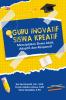
GURU INOVATIF SISWA KREATIF: Menciptakan Siswa Aktif, Adaptif, dan Responsif
Kata Kunci:
guru inovatif, siswa kreatifSinopsis
Dalam dinamika pendidikan masa kini, peran guru tidak lagi terbatas sebagai penyampai ilmu, melainkan sebagai inovator pembelajaran yang mampu menyalakan semangat berpikir kritis, kolaboratif, dan kreatif di kalangan siswa. Guru yang inovatif adalah agen perubahan yang mampu menciptakan suasana belajar yang menyenangkan, bermakna, dan relevan dengan kehidupan nyata. Sebaliknya, siswa masa depan perlu dibentuk menjadi individu yang aktif mencari pengetahuan, adaptif terhadap perkembangan zaman, serta responsif dalam menghadapi tantangan sosial dan teknologi yang terus berubah. Hadirnya buku berjudul “Guru Inovatif Siswa Kreatif: Menciptakan Siswa Aktif, Adaptif, Dan Responsif” ini lahir dari semangat untuk menghadirkan solusi nyata bagi dunia pendidikan yang tengah bertransformasi di era digital dan globalisasi yang serba cepat.
Buku ini disusun dengan pendekatan teoritis dan praktis yang berpijak pada pengalaman empiris dunia pendidikan. Setiap bab dirancang secara sistematis agar mudah dipahami dan diterapkan oleh berbagai kalangan — mulai dari guru, calon pendidik, mahasiswa pendidikan, hingga pemerhati dunia belajar. Disusun dalam 12 bab pembahasan, buku ini akan menyajikan dengan bahasa yang komunikatif, inspiratif, dan dilengkapi contoh-contoh kontekstual dari praktik pendidikan di Indonesia. Harapannya, buku ini tidak hanya menjadi bahan bacaan, tetapi juga menjadi pendamping profesional bagi para pendidik yang ingin menumbuhkan inovasi, kreativitas, dan karakter unggul di ruang kelasnya.
Bab
-
KATA PENGANTAR
-
DAFTAR ISI
-
DAFTAR TABEL
-
DAFTAR GAMBAR
-
Bab 1 Konsep Dasar Guru Inovatif
-
Bab 2 Siswa Kreatif sebagai Subjek Pembelajaran
-
Bab 3 Pembelajaran Aktif untuk Siswa
-
Bab 4 Siswa Adaptif di Era Perubahan
-
Bab 5 Responsivitas Siswa dalam Pembelajaran
-
Bab 6 Peran Teknologi dalam Mendorong Inovasi Guru
-
Bab 7 Model Pembelajaran Inovatif
-
Bab 8 Manajemen Kelas Kreatif dan Inovatif
-
Bab 9 Kolaborasi Guru, Siswa, dan Orang Tua
-
Bab 10 Pendidikan Karakter dalam Kreativitas
-
Bab 11 Kreativitas dalam Kegiatan Ekstrakurikuler
-
Bab 12 Best Practice Guru Inovatif, Siswa Kreatif
-
DAFTAR PUSTAKA
-
TENTANG PENULIS
Unduhan
Referensi
Almufarreh, A. and Arshad, M. (2023) ‘Promising Emerging Technologies for Teaching and Learning: Recent Developments and Future Challenges’, Sustainability, 15(8), p. 6917. Available at: https://doi.org/10.3390/su15086917.
Ansya, Y.A. and Salsabilla, T. (2024) Model Pembelajaran IPA di Sekolah Dasar. Cahya Ghani Recovery.
Ansya, Y.A. and Salsabilla, T. (2025) ‘Pembelajaran IPA berbasis Teknologi Informasi dan Komunikasi’, Jurnal Dunia Pendidikan, 5(5), pp. 1858–1877.
Ansya, Y.A., Salsabilla, T. and Mailani, E. (2025) ‘Peran Permainan Congklak untuk Meningkatkan Kemampuan Berhitung Siswa Sekolah Dasar’, JURNAL RISET PEMBELAJARAN MATEMATIKA SEKOLAH, 9(1), pp. 1–9. Available at: https://doi.org/10.21009/jrpms.091.01.
Ansya, Y.A., Salsabilla, T. and Rozi, F. (2025) Strategi Inovatif dalam Pengembangan Media Pembelajaran Sekolah Dasar di Era Society 5.0. Cahya Ghani Recovery.
Arifah, F.N. et al. (2025) ChatGPT di Era AI: Mengubah Cara Kita Berkomunikasi. Yayasan Kita Menulis.
Askar, R., Bragança, L. and Gervásio, H. (2021) ‘Adaptability of Buildings: A Critical Review on the Concept Evolution’, Applied Sciences, 11(10), p. 4483. Available at: https://doi.org/10.3390/app11104483.
Assen, J.H.E. and Otting, H. (2022) ‘Teachers’ collective learning: To what extent do facilitators stimulate the use of social context, theory, and practice as sources for learning?’, Teaching and Teacher Education, 114, p. 103702. Available at: https://doi.org/10.1016/j.tate.2022.103702.
Autio, E., Mudambi, R. and Yoo, Y. (2021) ‘Digitalization and globalization in a turbulent world: Centrifugal and centripetal forces’, Global Strategy Journal, 11(1), pp. 3–16. Available at: https://doi.org/10.1002/gsj.1396.
Bae, S.S. et al. (2023) ‘Cultivating Visualization Literacy for Children Through Curiosity and Play’, IEEE Transactions on Visualization and Computer Graphics, 29(1), pp. 257–267. Available at: https://doi.org/10.1109/TVCG.2022.3209442.
Baharuddin, M.R., Nasution, N.E.A., et al. (2025) Pembelajaran Interaktif Berbasis Teknologi. Yayasan Kita Menulis.
Baharuddin, M.R., Salamun, S., et al. (2025) Pengembangan Profesional Guru. Yayasan Kita Menulis.
Barut Tugtekin, E. and Dursun, O.O. (2022) ‘Effect of animated and interactive video variations on learners’ motivation in distance Education’, Education and Information Technologies, 27(3), pp. 3247–3276. Available at: https://doi.org/10.1007/s10639-021-10735-5.
Burden, P.R. (2025) Classroom management: Creating a successful K-12 learning community. John Wiley & Sons.
Capone, R. (2022) ‘Blended Learning and Student-centered Active Learning Environment: a Case Study with STEM Undergraduate Students’, Canadian Journal of Science, Mathematics and Technology Education, 22(1), pp. 210–236. Available at: https://doi.org/10.1007/s42330-022-00195-5.
Cheng, H.-Y., Tian, R.-M. and Mei, X.-X. (2023) ‘Comparing the behavioural differences of teachers and students in learner-centred classrooms between China and the USA’, European Journal of Psychology of Education, 38(1), pp. 63–82. Available at: https://doi.org/10.1007/s10212-021-00592-8.
Conrad, C. et al. (2022) ‘How student perceptions about online learning difficulty influenced their satisfaction during Canada’s Covid‐19 response’, British Journal of Educational Technology, 53(3), pp. 534–557. Available at: https://doi.org/10.1111/bjet.13206.
Conradty, C. and Bogner, F.X. (2022) ‘Measuring Students’ School Motivation’, Education Sciences, 12(6), p. 378. Available at: https://doi.org/10.3390/educsci12060378.
Dare, E.A. et al. (2021) ‘Beyond Content: The Role of STEM Disciplines, Real-World Problems, 21st Century Skills, and STEM Careers within Science Teachers’ Conceptions of Integrated STEM Education’, Education Sciences, 11(11), p. 737. Available at: https://doi.org/10.3390/educsci11110737.
Dickinson, J., Griffiths, T.-L. and Bredice, A. (2021) ‘“It’s just another thing to think about”: encouraging students’ engagement in extracurricular activities’, Journal of Further and Higher Education, 45(6), pp. 744–757. Available at: https://doi.org/10.1080/0309877X.2020.1813263.
Dishon, G. and Gilead, T. (2021) ‘ADAPTABILITY AND ITS DISCONTENTS: 21ST-CENTURY SKILLS AND THE PREPARATION FOR AN UNPREDICTABLE FUTURE’, British Journal of Educational Studies, 69(4), pp. 393–413. Available at: https://doi.org/10.1080/00071005.2020.1829545.
Esenyel, V. (2024) ‘Evolving Leadership Theories: Integrating Contemporary Theories for VUCA Realities’, Administrative Sciences, 14(11), p. 270. Available at: https://doi.org/10.3390/admsci14110270.
Fredagsvik, M.S. (2023) ‘The challenge of supporting creativity in problem-solving projects in science: a study of teachers’ conversational practices with students’, Research in Science & Technological Education, 41(1), pp. 289–305. Available at: https://doi.org/10.1080/02635143.2021.1898359.
Fuller, M. et al. (2021) ‘Conceptualizing Empathy Competence: A Professional Communication Perspective’, Journal of Business and Technical Communication, 35(3), pp. 333–368. Available at: https://doi.org/10.1177/10506519211001125.
Gul, R. and Khilji, G. (2021) ‘Exploring the need for a responsive school curriculum to cope with the Covid-19 pandemic in Pakistan’, PROSPECTS, 51(1–3), pp. 503–522. Available at: https://doi.org/10.1007/s11125-020-09540-8.
Halimah, L., Yuliariatiningsih, M.S. and Mirawati (2023) ‘Strategies for optimizing partnership: workshop on teamwork for teachers and parents in early childhood education’, International Journal of Early Years Education, pp. 1–18. Available at: https://doi.org/10.1080/09669760.2023.2299239.
Hamzah, H., Hamzah, M.I. and Zulkifli, H. (2022) ‘Systematic Literature Review on the Elements of Metacognition-Based Higher Order Thinking Skills (HOTS) Teaching and Learning Modules’, Sustainability, 14(2), p. 813. Available at: https://doi.org/10.3390/su14020813.
Hasanah, E. et al. (2022) ‘Conceptual Model of Differentiated-Instruction (DI) Based on Teachers’ Experiences in Indonesia’, Education Sciences, 12(10), p. 650. Available at: https://doi.org/10.3390/educsci12100650.
Ho-Minh, T. (2025) ‘Designing for Engagement: The Motivational Impact of Aesthetic Learning Spaces in Vietnamese EFL Classrooms’, Educational Process International Journal, 17(1). Available at: https://doi.org/10.22521/edupij.2025.17.378.
Holman, D. and Švejdarová, E. (2023) ‘The 21st-Century Empowering Wholeness Adaptive (EWA) Educational Model Transforming Learning Capacity and Human Capital through Wholeness Systems Thinking towards a Sustainable Future’, Sustainability, 15(2), p. 1301. Available at: https://doi.org/10.3390/su15021301.
Howell, R.A. (2021) ‘Engaging students in education for sustainable development: The benefits of active learning, reflective practices and flipped classroom pedagogies’, Journal of Cleaner Production, 325, p. 129318. Available at: https://doi.org/10.1016/j.jclepro.2021.129318.
Khan, S., Ramsey, P. and Khan, M. (2025) ‘Embracing educational transformation: Exploring personalised, collaborative and contextualised education through dilemma theory’, Innovations in Education and Teaching International, 62(1), pp. 349–362. Available at: https://doi.org/10.1080/14703297.2023.2283614.
Kučera, E. and Haffner, O. (2025) ‘Competency-Based Hybrid Learning: A Modern Approach to Teaching Programming and Digital Technologies Subjects’, IEEE Access, 13, pp. 54892–54919. Available at: https://doi.org/10.1109/ACCESS.2025.3555333.
López-Fernández, C. et al. (2023) ‘Putting critical thinking at the center of history lessons in primary education through error- and historical thinking-based instruction’, Thinking Skills and Creativity, 49, p. 101316. Available at: https://doi.org/10.1016/j.tsc.2023.101316.
Lukman, L. et al. (2021) ‘Effective teachers’ personality in strengthening character education’, International Journal of Evaluation and Research in Education (IJERE), 10(2), p. 512. Available at: https://doi.org/10.11591/ijere.v10i2.21629.
Mas’ud, H. et al. (2025) Manajemen Teknologi Informasi: Strategi dan Implementasi. Yayasan Kita Menulis.
Ourda, D. et al. (2025) ‘The Role of School Environment on the Sustainable Development of Pre-Schoolers’ Motor Creativity’, Sports, 13(7), p. 229. Available at: https://doi.org/10.3390/sports13070229.
Purba, P.B. et al. (2025) Strategi Belajar dan Pembelajaran Matematika: Meningkatkan Kualitas Proses dan Hasil Belajar. Yayasan Kita Menulis.
Purba, S.R.F. et al. (2025) Pendekatan Saintifik dalam Pembelajaran IPA. Yayasan Kita Menulis.
Rahmadani, E. et al. (2025) Manajemen Kelas yang Kreatif. Yayasan Kita Menulis.
Raissouni, D. et al. (2025) ‘Advancing Towards an Educational Revolution: Artificial Intelligence’s Contribution to Developing Soft Skills for Future Educators’, Proceedings of the E-Learning and Smart Engineering Systems (ELSES 2024), 36, p. 227.
Rozi, F., Ansya, Y.A. and Salsabilla, T. (2024) Strategi Pendidikan Karakter Untuk Siswa Sekolah Dasar Dalam Mewujudkan Tujuan SDG 4: Pendidikan Berkualitas. PT. Penerbit Naga Pustaka.
Seery, C. et al. (2021) ‘Students as Partners in Peer Mentoring: Expectations, Experiences and Emotions’, Innovative Higher Education, 46(6), pp. 663–681. Available at: https://doi.org/10.1007/s10755-021-09556-8.
Sitompul, R.S. et al. (2025) Revolusi Manajemen Pendidikan: Dari Konvensional ke Transformasional. Yayasan Kita Menulis.
Srimulyani, V.A. and Hermanto, Y.B. (2022) ‘Organizational culture as a mediator of credible leadership influence on work engagement: empirical studies in private hospitals in East Java, Indonesia’, Humanities and Social Sciences Communications, 9(1), p. 274. Available at: https://doi.org/10.1057/s41599-022-01289-z.
Subakti, H. et al. (2025) Sekolah Masa Depan: Mengintegrasikan AI dan Pembelajaran Interaktif. Yayasan Kita Menulis.
Sutrisno, E. et al. (2025) Pendidikan Kependudukan dan Lingkungan Hidup. Yayasan Kita Menulis.
Talebizadeh, S.M., Hosseingholizadeh, R. and Bellibaş, M.Ş. (2021) ‘Analyzing the relationship between principals’ learning-centered leadership and teacher professional learning: The mediation role of trust and knowledge sharing behavior’, Studies in Educational Evaluation, 68, p. 100970. Available at: https://doi.org/10.1016/j.stueduc.2020.100970.
Tampubolon, S.H. et al. (2025) ChatGPT di Era AI: Revolusi Komunikasi Berbasis Mesin. Yayasan Kita Menulis.
Tang, Y. and Hew, K.F. (2022) ‘Effects of using mobile instant messaging on student behavioral, emotional, and cognitive engagement: a quasi-experimental study’, International Journal of Educational Technology in Higher Education, 19(1), p. 3. Available at: https://doi.org/10.1186/s41239-021-00306-6.
Tromp, C. and Baer, J. (2022) ‘Creativity from constraints: Theory and applications to education’, Thinking Skills and Creativity, 46, p. 101184. Available at: https://doi.org/10.1016/j.tsc.2022.101184.
Vistorte, A.O.R. et al. (2024) ‘Integrating artificial intelligence to assess emotions in learning environments: a systematic literature review’, Frontiers in Psychology, 15. Available at: https://doi.org/10.3389/fpsyg.2024.1387089.
Watts, P., Fullard, M. and Peterson, A. (2021) Understanding character education: Approaches, applications and issues. McGraw-Hill Education (UK).
Yadav, A. and Singh, S. (2024) ‘Environment and Development: Balancing Progress, Preserving the Planet and Fostering Collaboration for a Sustainable Future’, in, pp. 309–324. Available at: https://doi.org/10.1007/978-3-031-51696-2_12.
Young-Bruehl, E. (2025) Creative characters. Taylor & Francis.