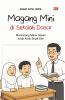
MAGANG MINI DI SEKOLAH DASAR: Merancang Masa Depan Kerja Anak Sejak Dini
Kata Kunci:
SEKOLAH , DASARSinopsis
Buku ini menghadirkan gagasan segar tentang bagaimana sekolah dasar dapat menjadi laboratorium kehidupan bagi anak- anak. Melalui konsep Magang Mini, siswa diberi peran sederhana namun bermakna-seperti menjaga perpustakaan mini, membantu di kantin, merawat taman sekolah, hingga menulis laporan harian. Dari aktivitas kecil inilah lahir nilai-nilai besar. disiplin, tanggung jawab, kerja sama, kepedulian, dan kejujuran. Ditulis dengan perpaduan antara landasan akademik dan narasi inspiratif, buku ini menuntun guru, orang tua, dan praktisi pendidikan untuk memahami bahwa reward dan apresiasi bukan sekadar hadiah, melainkan sarana membangun karakter. Setiap bab menguraikan prinsip, strategi, kisah nyata, hingga refleksi praktis yang bisa langsung diterapkan di ruang kelas maupun di rumah.
Buku ini mengajak pembaca untuk melihat bahwa pendidikan yang sederhana pun bisa berdampak luar biasa. Akhirnya, buku ini menegaskan bahwa Magang Mini adalah investasi kecil dengan dampak besar. la adalah jembatan yang menghubungkan teori dengan praktik, sekolah dengan dunia nyata, dan anak-anak dengan masa depan mereka. Dari ruang kelas yang sederhana, kita sedang menyiapkan Generasi Emas Indonesia 2045: generasi yang tangguh, mandiri, dan berkarakter.
“Setiap anak adalah bintang. Apresiasi membuat mereka berani bersinar lebih terang.”
Bab
-
KATA PENGANTAR
-
DAFTAR ISI
-
UNIT 1 MENGAPA MAGANG MINI DI SEKOLAH DASAR?
-
UNIT 2 DUNIA KERJA DAN ANAK USIA SEKOLAH
-
UNIT 3 MEMBANGUN KARAKTER DAN TANGGUNG JAWAB SEJAK DINI
-
UNIT 4 REWARD DAN APRESIASI: MENUMBUHKAN MOTIVASI DAN KARAKTER POSITIF
-
UNIT 5 KETERAMPILAN ABAD 21 UNTUK ANAK SD
-
UNIT 6 MERANCANG PROGRAM MAGANG MINI DI SEKOLAH DASAR
-
UNIT 7 KELAS KARIER UNTUK ANAK
-
UNIT 8 DAMPAK POSITIF PROGRAM MAGANG MINI
-
UNIT 9 SEKOLAH SEBAGAI JEMBATAN KE DUNIA NYATA
-
UNIT 10 PENUTUP: MENUJU GENERASI EMAS DENGAN MAGANG MINI
-
PROFIL PENULIS
Unduhan
Referensi
Afriani, N., & Hermita, N. (2020). Keterampilan abad 21 dalam pendidikan dasar. Jurnal Pendidikan Dasar, 11(2), 101–112.
Dewey, J. (1938). Experience and education. New York: Macmillan.
Dweck, C. S. (2016). Mindset: The New Psychology of Success. Ballantine Books.
Heckman, J. J., & Kautz, T. (2012). Hard evidence on soft skills. Labour Economics, 19(4), 451–464. https://doi.org/10. 1016/j.labeco.2012.05.014
Heckman, J. J., & Kautz, T. (2012). Hard evidence on soft skills. Labour Economics, 19(4), 451–464. https://doi.org/10. 1016/j.labeco.2012.05.014
Kemendikbudristek. (2022). Kurikulum merdeka untuk pembelajaran yang lebih merdeka. Jakarta: Kementerian Pendidikan, Kebudayaan, Riset, dan Teknologi.
Kolb, D. A. (2015). Experiential learning: Experience as the source of learning and development (2nd ed.). Pearson Education.
Lickona, T. (2012). Educating for Character: How Our Schools Can Teach Respect and Responsibility. Bantam.
McCrindle, M. (2021). Generation Alpha: Understanding Our Children and Helping Them Thrive. Hachette.
OECD. (2019). PISA 2018 Results. OECD Publishing.
Piaget, J. (2002). The Language and Thought of the Child. Routledge. (Original work published 1927).
Tews, M. J., & Noe, R. A. (2019). Does training and development really matter? A meta-analysis of the relationship between experiential learning and work outcomes. Human Resource Management Review, 29(2), 149–164. https://doi.org/10. 1016/j.hrmr.2018.07.002
Trilling, B., & Fadel, C. (2009). 21st century skills: Learning for life in our times. San Francisco: Jossey-Bass.
World Bank. (2018). World development report 2018: Learning to realize education’s promise. Washington, DC: World Bank.
World Bank. (2020). The Promise of Education in Indonesia. World Bank.
World Economic Forum. (2020). The Future of Jobs Report 2020. Geneva: WEF.
Aliyyah, R. R., Rachmadtullah, R., Samsudin, A., Syaodih, E., Nurtanto, M., & Tambunan, A. R. S. (2020). The perceptions of primary school teachers of online learning during the COVID-19 pandemic period: A case study in Indonesia. Journal of Ethnic and Cultural Studies, 7(2), 90–109. https://doi.org/10.29333/ejecs/388
Heckman, J. J., & Kautz, T. (2013). Fostering and Measuring Skills: Interventions that Improve Character and Cognition. NBER Working Paper.
Kolb, D. A. (2015). Experiential learning: Experience as the source of learning and development. FT press.
Lavy, V. (2016). Do differences in schools’ instruction time explain international achievement gaps? Evidence from developed and developing countries. Economic Journal, 126(593), 397–424.
Montessori, M. (2007). The Absorbent Mind. Read Books Ltd.
OECD. (2018). The Future of Education and Skills: Education 2030. OECD Publishing.
Trilling, B., & Fadel, C. (2009). 21st century skills: Learning for life in our times. John Wiley & Sons.
Vygotsky, L. S. (2012). Mind in Society: The Development of Higher Psychological Processes. Harvard University Press. (Original work published 1978).
Wang, M.-T., & Degol, J. L. (2016). School climate: A review of the construct, measurement, and impact on student outcomes. Educational Psychology Review, 28(2), 315–352. https://doi.org/ 10.1007/s10648-015-9319-1
Wright, A., Betteridge, D., & Buckby, M. (2019). Games for language learning. Cambridge University Press.
Bandura, A. (2018). Toward a psychology of human agency: Pathways and reflections. Perspectives on Psychological Science, 13(2), 130–136.
Dewi, R. (2014). Mengajarkan Disiplin Waktu pada Anak: Konsep dan Praktik di Sekolah Dasar. Jakarta: Penerbit Karya.
Dweck, C. S. (2006). Mindset: The New Psychology of Success. New York: Random House.
Goleman, D. (2006). Emotional Intelligence: Why It Can Matter More Than IQ. New York: Bantam.
Johnson, D. W., & Johnson, F. P. (1999). Joining Together: Group Theory and Group Skills (7th ed.). Boston: Allyn & Bacon.
Lickona, T. (2004). Character Matters: How to Help Our Children Develop Good Judgment, Integrity, and Other Essential Virtues. New York: Touchstone.
Lickona, T. (2018). Educating for character: How our schools can teach respect and responsibility. Bantam Books.
McClelland, D. C. (2011). The Achieving Society. Princeton: Van Nostrand.
Nikolajeva, M. (2019). Reading for learning: Cognitive approaches to children's literature. John Benjamins.
Wang, C., & Yang, L. (2020). Storytelling as a pedagogical tool to promote character education in primary schools. Journal of Moral Education, 49(4), 453–468.
Bandura, A. (2018). Toward a psychology of human agency: Pathways and reflections. Perspectives on Psychological Science, 13(2), 130–136.
Brophy, J. (2010). Motivating students to learn (3rd ed.). New York: Routledge.
Chen, Y. (2023). External rewards and intrinsic motivation: Rethinking reinforcement in education. Journal of Educational Psychology Research, 45(2), 112–128. https://doi.org/10. 1080/xxxx.
Deci, E. L., & Ryan, R. M. (2000). The “what” and “why” of goal pursuits: Human needs and the self-determination of behavior. Psychological Inquiry, 11(4), 227–268. https://doi. org/10.1207/S15327965PLI1104_01
Lickona, T. (2004). Character matters: How to help our children develop good judgment, integrity, and other essential virtues. New York: Touchstone.
Lickona, T. (2018). Educating for character: How our schools can teach respect and responsibility. Bantam Books.
Recognition for Positive Behavior. (2012). Positive behavioral interventions and supports: A framework for school-wide improvement. U.S. Department of Education.
Wang, C., & Yang, L. (2020). Storytelling as a pedagogical tool to promote character education in primary schools. Journal of Moral Education, 49(4), 453–468. https://doi.org/10.1080/ 03057240.2019.1705878
Bandura, A. (2018). Toward a psychology of human agency. Perspectives on Psychological Science, 13(2), 130–136. https://doi.org/10.1177/ 1745691617699280
Bass, B. M. (1990). Bass & Stogdill's Handbook of Leadership: Theory, Research, and Managerial Applications (3rd ed.). New York: Free Press.
Epstein, J. L. (2018). School, Family, and Community Partnerships: Preparing Educators and Improving Schools. Routledge.
Goman, C. K. (2020). The Silent Language of Leaders: How Body Language Can Help—or Hurt—How You Lead. John Wiley & Sons.
Moffett, J. (2017). Role play and experiential learning in the classroom. Journal of Education and Practice, 8(6), 45–52.
Trilling, B., & Fadel, C. (2009). 21st Century Skills: Learning for Life in Our Times. Jossey-Bass.
Pennington, M., & Johnson, M. (2018). Effective Writing Skills for Business and Professional Communication. Oxford: Oxford University Press.
Garton, S., & Pratt, C. (2019). Language for Learning: The Development of Writing Skills in Primary Education. London: Routledge.
Graham, S. (2020). The development of writing skills. Educational Psychologist, 55(4), 250–262. https://doi.org/10.1080/00461520.2020.1786386
Graham, S., Kiuhara, S. A., & MacKay, M. (2019). The effects of writing on learning in science, social studies, and mathematics: A meta-analysis. Review of Educational Research, 89(4), 646–678. https://doi.org/10.3102/00346543198 62494
Hyland, K. (2016). Teaching and Researching Writing (3rd ed.). Routledge.
Goleman, D. (2019). Working with emotional intelligence. New York: Bantam Books.
Spencer, L. M., & Spencer, S. M. (2017). Competence at work: Models for superior performance. New York: Wiley.
Trilling, B., & Fadel, C. (2009). 21st century skills: Learning for life in our times. San Francisco: Jossey-Bass.
Woolfolk, A. (2020). Educational psychology (14th ed.). New York: Pearson.
Bell, C., et al. (2024). Learning through language: The importance of emotion in early social-emotional learning. Journal of Educational Psychology, 116(3), 45–62. (ScienceDirect)
Hosokawa, R., et al. (2024). Enhancing social-emotional skills in early childhood. *PMC * (NCBI). (PMC)
Bandura, A. (1997). Self-efficacy: The exercise of control. W.H. Freeman.
Durlak, J. A., Weissberg, R. P., Dymnicki, A. B., Taylor, R. D., & Schellinger, K. B. (2011). The impact of enhancing students’ social and emotional learning: A meta‐analysis of school‐based universal interventions. Child Development, 82(1), 405–432. https://doi.org/10.1111/j.1467-8624.2010.01564.x
Elias, M. J., Zins, J. E., Weissberg, R. P., Frey, K. S., Greenberg, M. T., Haynes, N. M., Kessler, R., Schwab-Stone, M. E., & Shriver, T. P. (1997). Promoting social and emotional learning: Guidelines for educators. ASCD.
Putra, I. G. N. E., & Sari, N. L. P. (2024). Experiential learning implementation to improve student engagement in Bali schools. In Proceedings of the International Conference on Education and Social Science (ICESS-24) (pp. 112–120). Atlantis Press. https://www.atlantis-press.com/proceedings/icess-24/126010423
Vygotsky, L. S. (1978). Mind in society: The development of higher psychological processes. Harvard University Press.
Wibowo AH, Mohamad B, Djatmika and Santosa R (2024). Designing and assessing experiential learning pedagogy for an intercultural communicative competence training module: a quasi-experimental study. Front. Educ. 9:1470209. doi: 10.3389/feduc.2024.1470209 https://www.frontiersin.org/journals/education/articles/10.3389/feduc.2024.1470209/full
Wibowo, S., Nugroho, A., & Rahardjo, B. (2024). Experiential learning-based module redesign to enhance active learning and reflection. Frontiers in Education, 9, 1470209. https://www.frontiersin.org/journals/education/articles/10.3389/feduc.2024.1470209
Zhao, Y., Zhang, Y., & Liu, H. (2024). Academic self-efficacy mediates the relationship between subjective well-being and academic achievement among students. Frontiers in Psychology, 15, 12061889. https://pmc.ncbi.nlm.nih.gov/articles/PMC 12061889
Brock, D. D., & Grady, M. (2020). Building resilience in children: The role of experiential learning. Journal of Educational Psychology, 112(3), 450-463. https://doi.org/10.1037/edu0000398
Dweck, C. S. (2006). Mindset: The new psychology of success. Random House.
Heckman, J. J., & Kautz, T. (2013). Fostering and measuring skills: Interventions that improve character and cognition. In J. J. Heckman, J. H. Humphries, & G. J. Moon (Eds.), The economics of human development and social mobility (pp. 251–278). Cambridge University Press.
Kolb, D. A. (2015). Experiential learning: Experience as the source of learning and development (2nd ed.). Pearson Education.
Nasution, M. I. (2016). Character building through Islamic education: A study in Indonesia. International Journal of Educational Research, 72, 67–76. https://doi.org/10. 1016/j.ijer.2015.11.008
Tews, M. J., & Noe, R. A. (2019). Effects of experiential learning on students' engagement and motivation. Journal of Educational Psychology, 111(2), 231–247. https://doi.org/10.1037/ edu0000345