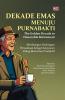
DEKADE EMAS MENUJU PURNABAKTI: The Golden Decade to Honorable Retirement
Kata Kunci:
DEKADE EMAS MENUJU PURNABAKTISinopsis
Buku “Dekade Emas Menuju Purnabakti” ditulis untuk menyadarkan sekaligus membimbing para karyawan agar tidak terlambat menyiapkan masa purna tugasnya.
Buku ini menegaskan bahwa 10 tahun terakhir sebelum pensiun adalah masa paling krusial—bukan masa penurunan, melainkan masa puncak dari segala kehebatan hidup seorang profesional: puncak keahlian, kepemimpinan, produktivitas, pengaruh sosial, hingga kebijaksanaan hidup. Buku ini memetakan sepuluh puncak penting yang dapat dan seharusnya dicapai setiap karyawan, sekaligus membantu pembaca menemukan jalur kehebatan yang paling sesuai dengan potensinya.
Dengan bahasa yang lugas dan reflektif, buku ini tidak hanya memberi wawasan, tetapi juga menggerakkan. Ini adalah panduan strategis bagi siapa pun yang ingin memasuki masa pensiun bukan dengan kebingungan atau kekosongan, tetapi dengan arah hidup yang jelas, kesiapan finansial yang mantap, relasi yang sehat, serta makna yang dalam.
Jika Anda merasa sudah terlambat, buku ini memberi harapan bahwa Anda masih punya waktu. Jika Anda merasa sudah siap, buku ini akan memastikan bahwa kesiapan Anda benar-benar utuh. Pensiun bukanlah akhir, melainkan awal dari kontribusi terbaik yang pernah Anda berikan.
Bab
-
KATA PENGANTAR
-
DAFTAR ISI
-
BAB 1 DEKADE EMAS BUKAN DEKADE CEMAS
-
BAB 2 PUNCAK KEAHLIAN (EXPERTISE)
-
BAB 3 PUNCAK KECAKAPAN MEMIMPIN
-
BAB 4 PUNCAK PRODUKTIVITAS (EFEKTIVITAS DAN EFISIENSI)
-
BAB 5 PUNCAK PENDAPATAN DAN STABILITAS FINANSIAL
-
BAB 6 PUNCAK PENGARUH DAN JEJARING SOSIAL
-
BAB 7 PUNCAK KEBIJAKSANAAN DALAM PENGAMBILAN KEPUTUSAN
-
BAB 8 PUNCAK RASA PERCAYA DIRI
-
BAB 9 PUNCAK KEMATANGAN EMOSI DAN RELASI
-
BAB 10 PUNCAK PEMAHAMAN MAKNA DAN TUJUAN HIDUP
-
BAB 11 PUNCAK (FINALISASI) ROADMAP KEHIDUPAN
-
BAB 12 ASSESSMENT, PLANNING, IMPLEMENT, EVALUATE (APIE)
-
BAB 13 PILIHAN JALUR KEHEBATAN
-
BAB 14 SUPPORT SYSTEM KEBERHASILAN
-
DAFTAR PUSTAKA
-
PROFIL PENULIS
Unduhan
Referensi
Allen, D. (2001). Getting things done: The art of stress-free productivity. Penguin Books.
Allen, T. D., & Eby, L. T. (Eds.). (2007). The Blackwell handbook of mentoring: A multiple perspectives approach. Blackwell Publishing.
Argyris, C. (1977). Double loop learning in organizations. Harvard Business Review, 55(5), 115–125.
Argyris, C. (1991). Teaching smart people how to learn. Harvard Business Review, 69(3), 99–109.
Atchley, R. C. (1999). Continuity and Adaptation in Aging: Creating Positive Experiences. Johns Hopkins University Press.
Baltes, P. B., & Staudinger, U. M. (2000). Wisdom: A metaheuristic (pragmatic) to orchestrate mind and virtue toward excellence. American Psychologist, 55(1), 122–136. https://doi.org/10.1037/0003-066X.55.1.122
Beehr, T. A. (1986). The process of retirement: A review and recommendations for future investigation. Personnel Psychology, 39(1), 31–55.
Bridges, W. (2004). Transitions: Making sense of life’s changes. Da Capo Press.
Brousseau, K. R., Driver, M. J., Hourihan, G., & Larsson, J. (2006). The seasoned executive’s decision-making style. Harvard Business Review, 84(2), 110–121.
Brown, B. (2012). Daring greatly: How the courage to be vulnerable transforms the way we live, love, parent, and lead. Gotham Books.
Brown, B. (2018). Braving the wilderness: The quest for true belonging and the courage to stand alone. Random House.
Burt, R. S. (2005). Brokerage and Closure: An Introduction to Social Capital. Oxford University Press.
Butler, R. N. (1963). The life review: An interpretation of reminiscence in the aged. Psychiatry, 26(1), 65–76.
Carstensen, L. L., Fung, H. H., & Charles, S. T. (2003). Socioemotional selectivity theory and the regulation of emotion in the second half of life. Motivation and Emotion, 27(2), 103–123.
Carstensen, L. L., Isaacowitz, D. M., & Charles, S. T. (1999). Taking time seriously: A theory of socioemotional selectivity. American Psychologist, 54(3), 165–181. https://doi.org/10.1037/0003-066X.54.3.165
Catmull, E., & Wallace, A. (2014). Creativity, Inc.: Overcoming the unseen forces that stand in the way of true inspiration. Random House.
Clutterbuck, D. (2004). Everyone needs a mentor: Fostering talent in your organisation. CIPD Publishing.
Conger, J. A., & Fulmer, R. M. (2003). Developing your leadership pipeline. Harvard Business Review, 81(12), 76–84.
Covey, S. R. (1989). The 7 habits of highly effective people. Free Press.
Deci, E. L., & Ryan, R. M. (2000). The “what” and “why” of goal pursuits: Human needs and the self-determination of behavior. Psychological Inquiry, 11(4), 227–268. https://doi.org/10.1207/S15327965PLI1104_01
Drucker, P. F. (2007). The Effective Executive: The Definitive Guide to Getting the Right Things Done. HarperBusiness.
Edmondson, A. (1999). Psychological safety and learning behavior in work teams. Administrative Science Quarterly, 44(2), 350–383.
Ericsson, K. A., Charness, N., Feltovich, P. J., & Hoffman, R. R. (Eds.). (2006). The Cambridge Handbook of Expertise and Expert Performance. Cambridge University Press.
Erikson, E. H. (1950). Childhood and society. Norton.
Erikson, E. H. (1982). The Life Cycle Completed. W. W. Norton & Company.
Fernandes, D., Lynch Jr, J. G., & Netemeyer, R. G. (2014). Financial literacy, financial education, and downstream financial behaviors. Management Science, 60(8), 1861–1883.
Ferris, G. R., Treadway, D. C., Perrewé, P. L., Brouer, R. L., Douglas, C., & Lux, S. (2005). Political skill in organizations. Journal of Management, 31(6), 747–770.
Frank, R. H. (2007). Falling behind: How rising inequality harms the middle class. University of California Press.
Frankl, V. E. (1985). Man’s search for meaning. Washington Square Press.
Goleman, D. (1995). Emotional intelligence: Why it can matter more than IQ. Bantam Books.
Goleman, D. (2006). Social intelligence: The new science of human relationships. Bantam.
Granovetter, M. S. (1973). The strength of weak ties. American Journal of Sociology, 78(6), 1360–1380.
Hall, D. T. (2002). Careers in and out of organizations. SAGE Publications.
Heifetz, R., & Linsky, M. (2002). Leadership on the line: Staying alive through the dangers of leading. Harvard Business Press.
Hershey, D. A., Jacobs-Lawson, J. M., McArdle, J. J., & Hamagami, F. (2007). Psychological foundations of financial planning for retirement. Journal of Adult Development, 14(1), 26–36.
Higgins, M. C., & Kram, K. E. (2001). Reconceptualizing mentoring at work: A developmental network perspective. Academy of Management Review, 26(2), 264–288. https://doi.org/10.5465/amr.2001.4378023
Hira, T. K., & Loibl, C. (2005). Understanding the impact of employer-provided financial education on workplace satisfaction. Journal of Consumer Affairs, 39(1), 173–194. https://doi.org/10.1111/j.1745-6606.2005.00009.x
Ibarra, H., & Hunter, M. (2007). How leaders create and use networks. Harvard Business Review, 85(1), 40–47.
Kaplan, R. S., & Norton, D. P. (2004). Strategy maps: Converting intangible assets into tangible outcomes. Harvard Business Press.
Kegan, R., & Lahey, L. L. (2009). Immunity to change: How to overcome it and unlock potential in yourself and your organization. Harvard Business Press.
Kessler, D. (2020). Finding meaning: The sixth stage of grief. Scribner.
Kim, J. E., & Moen, P. (2002). Retirement transitions, gender, and psychological well-being: A life-course, ecological model. The Journals of Gerontology: Series B, 57(3), P212–P222. https://doi.org/10.1093/geronb/57.3.P212
Knowles, M. S., Holton, E. F., & Swanson, R. A. (2015). The adult learner: The definitive classic in adult education and human resource development (8th ed.). Routledge.
Kolb, D. A. (1984). Experiential learning: Experience as the source of learning and development. Prentice Hall.
Kouzes, J. M., & Posner, B. Z. (2012). The Leadership Challenge: How to Make Extraordinary Things Happen in Organizations (5th ed.). Jossey-Bass.
Levinson, D. J. (1978). The seasons of a man's life. Ballantine Books.
London, M. (2003). Job feedback: Giving, seeking, and using feedback for performance improvement (2nd ed.). Psychology Press.
Lusardi, A., & Mitchell, O. S. (2011). Financial literacy and planning: Implications for retirement wellbeing. National Bureau of Economic Research Working Paper, No. 17078. https://doi.org/10.3386/w17078
Lusardi, A., & Mitchell, O. S. (2014). The economic importance of financial literacy: Theory and evidence. Journal of Economic Literature, 52(1), 5–44.
Malkiel, B. G. (2015). A random walk down Wall Street: The time-tested strategy for successful investing. W. W. Norton & Company.
Mark, G., Gudith, D., & Klocke, U. (2008). The cost of interrupted work: More speed and stress. In Proceedings of the SIGCHI conference on human factors in computing systems.
Maslach, C., & Leiter, M. P. (1997). The truth about burnout: How organizations cause personal stress and what to do about it. Jossey-Bass.
McAdams, D. P., & de St. Aubin, E. (1992). A theory of generativity and its assessment through self-report, behavioral acts, and narrative themes in autobiography. Journal of Personality and Social Psychology, 62(6), 1003–1015. https://doi.org/10.1037/0022-3514.62.6.1003
McCall, M. W., Lombardo, M. M., & Morrison, A. M. (1988). The lessons of experience: How successful executives develop on the job. Lexington Books.
Merton, R. C. (2014). The crisis in retirement planning. Harvard Business Review, 92(7/8), 43–50.
Neff, K. D. (2011). Self-compassion: The proven power of being kind to yourself. William Morrow.
Newport, C. (2016). Deep work: Rules for focused success in a distracted world. Grand Central Publishing.
OECD. (2020). OECD/INFE 2020 International Survey of Adult Financial Literacy. OECD Publishing.
Petkoska, J., & Earl, J. K. (2009). Understanding the influence of demographic and psychological variables on retirement planning. Psychology and Aging, 24(1), 245–251.
Prensky, M. (2001). Digital natives, digital immigrants. On the Horizon, 9(5), 1–6.
Rogers, C. R. (1961). On becoming a person: A therapist’s view of psychotherapy. Houghton Mifflin.
Rosenberg, M. B. (2003). Nonviolent communication: A language of life. Puddle Dancer Press.
Salovey, P., & Mayer, J. D. (1990). Emotional intelligence. Imagination, Cognition and Personality, 9(3), 185–211. https://doi.org/10.2190/DUGG-P24E-52WK-6CDG
Schlossberg, N. K. (2004). Retire smart, retire happy: Finding your true path in life. APA Life Tools.
Siegel, D. J. (2010). The mindful brain: Reflection and attunement in the cultivation of well-being. W. W. Norton & Company.
Siegel, D. J. (2012). The developing mind: How relationships and the brain interact to shape who we are. Guilford Press.
Sternberg, R. J. (1998). A balance theory of wisdom. Review of General Psychology, 2(4), 347–365. https://doi.org/10.1037/1089-2680.2.4.347
Stone, D., & Heen, S. (2014). Thanks for the feedback: The science and art of receiving feedback well. Viking.
Toffler, A. (1980). The third wave. Bantam Books.
Yura, H., & Walsh, M. B. (1967). The Nursing Process: Assessing, Planning, Implementing, Evaluating. Appleton-Century-Crofts.
Zenger, J. H., & Folkman, J. (2002). The extraordinary leader: Turning good managers into great leaders. McGraw Hill.