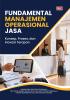
FUNDAMENTAL MANAJEMEN OPERASIONAL JASA: Konsep, Proses, dan Inovasi Terapan
Kata Kunci:
MANAJEMEN, MANAJEMEN OPERASIONAL, JASASinopsis
Buku “Fundamental Manajemen Operasional Jasa: Konsep, Proses, dan Inovasi Terapan” hadir untuk menjawab tantangan di era ekonomi modern, di mana sektor layanan telah berevolusi menjadi penggerak utama bisnis global. Buku ini mengupas tuntas bagaimana manajemen operasi di sektor jasa memiliki kompleksitas dan pendekatan strategis yang jauh berbeda dibandingkan dengan industri manufaktur fisik.
Di dalamnya, pembaca akan diajak untuk memahami empat karakteristik mendasar dari jasa, yakni sifatnya yang tidak berwujud (Intangibility), tidak dapat dipisahkan (Inseparability), sangat bervariasi (Variability), dan tidak dapat disimpan (Perishability). Lebih dari itu, buku ini mendobrak pandangan tradisional dengan memperkenalkan Service-Dominant Logic, di mana konsumen tidak lagi dipandang pasif, melainkan berperan aktif sebagai “Pencipta Bersama” (Co-Creator) dalam proses layanan, baik untuk skala individu (B2C) maupun antar-korporasi (B2B).
Dilengkapi dengan berbagai analogi terapan dan panduan perumusan strategi operasi yang komprehensif, buku ini menjadi referensi yang esensial. Karya ini sangat tepat bagi mahasiswa, akademisi, manajer, dan praktisi yang ingin mempelajari cara merancang serta mengelola sistem layanan yang adaptif, efisien, dan mampu memberikan keunggulan kompetitif yang berkelanjutan.
Bab
-
KATA PENGANTAR
-
DAFTAR ISI
-
BAB 01. KARAKTERISTIK DAN ESENSI MANAJEMEN OPERASIONAL JASA
-
BAB 02. MERUMUSKAN STRATEGI OPERASI JASA UNTUK KEUNGGULAN BERSAING
-
BAB 03. MERANCANG PENGALAMAN LAYANAN (SERVICE DESIGN)
-
BAB 04. MANAJEMEN KUALITAS LAYANAN (SERVICE QUALITY)
-
BAB 05. ANALISIS PROSES DAN ALIRAN KERJA JASA
-
BAB 06. STRATEGI LOKASI DAN TATA LETAK FASILITAS JASA
-
BAB 07. MANAJEMEN RANTAI PASOK JASA (SERVICE SUPPLY CHAIN)
-
BAB 08. MENGELOLA KAPASITAS DAN MENGENDALIKAN PERMINTAAN LAYANAN
-
BAB 09. PENJADWALAN SUMBER DAYA MANUSIA DAN LAYANAN
-
BAB 10. INOVASI, KINERJA, DAN KESIAPAN TEKNOLOGI LAYANAN
-
DAFTAR PUSTAKA
-
PROFIL PENULIS
Unduhan
Referensi
Allway, M., & Corbett, S. (2002). Shifting to lean service: Stealing a page from manufacturers’ playbooks. Journal of Organizational Excellence.
Antony, J. (2006). Six sigma for service processes. Business Process Management Journal, 12(2), 234–248.
Bakker, A. B., & Demerouti, E. (2007). The job demands-resources model: State of the art. Journal of Managerial Psychology, 22(3), 309–328.
Bitner, M. J. (1992). Servicescapes: The Impact of Physical Surroundings on Customers and Employees. Journal of Marketing, 56(2), 57–71.
Bitner, M. J., Brown, S. W., & Meuter, M. L. (2000). Technology infusion in service encounters. Journal of the Academy of Marketing Science, 28(1), 138–149.
Bonaccorsi, A., Carmignani, G., & Zammori, F. (2011). Service Value Stream Management (SVSM): Developing lean thinking in the service industry. Journal of Service Science and Management, 4(4).
Bortolotti, T., & Romano, P. (2012). Lean first, then automate: A framework for process improvement in pure service companies. Production Planning & Control, 23(7), 513–522.
Bowen, D. E., & Youngdahl, W. E. (1998). Lean service: In defense of a production-line approach. International Journal of Service Industry Management.
Carlborg, P., Kindström, D., & Kowalkowski, C. (2013). A lean approach to service productivity improvements: Synergy or oxymoron? Managing Service Quality, 23(4), 291–304.
Cooper, R. G. (2019). Winning at New Products: Creating Value Through Innovation (5th ed.). Basic Books.
Cross, R. G. (1997). Revenue Management: Hard-Core Tactics for Market Domination. Broadway Books.
Dessler, G. (2020). Human Resource Management (16th ed.). Pearson Education.
Fitzsimmons, J. A., & Fitzsimmons, M. J. (2014). Service Management: Operations, Strategy, Information Technology (8th ed.). McGraw-Hill Education.
Gupta, D., & Denton, B. (2008). Appointment scheduling in health care: Challenges and opportunities. IIE Transactions, 40(9), 800–819.
Hayes, D. K., & Miller, A. A. (2011). Revenue Management for the Hospitality Industry. John Wiley & Sons.
Héder, M. (2017). From NASA to EU: The evolution of the TRL scale in public sector innovation. The Innovation Journal, 22(2), 1–23.
Heizer, J., Render, B., & Munson, C. (2017). Operations Management: Sustainability and Supply Chain Management (12th ed.). Pearson Education.
Hochschild, A. R. (1983). The Managed Heart: Commercialization of Human Feeling. University of California Press.
Hurriyati, R. (2015). Bauran Pemasaran dan Loyalitas Konsumen. Bandung: Alfabeta.
Imai, M. (1986). Kaizen: The Key to Japan’s Competitive Success. McGraw-Hill.
Johnston, R., & Clark, G. (2008). Service Operations Management: Improving Service Delivery. Pearson Education.
Kahn, W. A. (1990). Psychological conditions of personal engagement and disengagement at work. Academy of Management Journal, 33(4), 692–724.
Kaplan, R. S., & Norton, D. P. (1996). The Balanced Scorecard: Translating Strategy into Action. Harvard Business School Press.
Kellogg, D. L., & Nie, W. (1995). A framework for strategic service management. Journal of Operations Management, 13(4), 323–337.
Kimes, S. E. (1989). Yield management: A tool for capacity-constrained service firms. Journal of Operations Management, 8(4), 348–363.
Kimes, S. E. (2011). The current state of online food ordering in the U.S. restaurant industry. Cornell Hospitality Report, 11(17), 6–18.
Kimes, S. E., & Wirtz, J. (2003). Has revenue management become acceptable? Findings from an international study on the perceived fairness of rate fences. Journal of Service Research, 6(2), 125–135.
Kotler, P., & Keller, K. L. (2016). Marketing Management (15th Edition). Pearson Education.
LaGanga, L. R. (2011). Lean service operations: Reflections and new directions for capacity expansion in outpatient clinics. Journal of Operations Management, 29(5), 422–433.
Leite, H. R., & Vieira, G. E. (2015). Lean philosophy and its applications in the service industry: A review of the current knowledge. Production, 25(3), 529–541.
Lovelock, C., & Wirtz, J. (2016). Services Marketing: People, Technology, Strategy (8th ed.). World Scientific Publishing.
Mankins, J. C. (1995). Technology readiness levels. White Paper, NASA Office of Space Access and Technology.
Mankins, J. C. (2009). Technology readiness assessments: A retrospective. Acta Astronautica, 65(9–10), 1216–1223.
Maslach, C., & Jackson, S. E. (1981). The measurement of experienced burnout. Journal of Occupational Behavior, 2(2), 99–113.
Maslach, C., Schaufeli, W. B., & Leiter, M. P. (2001). Job burnout. Annual Review of Psychology, 52(1), 397–422.
Nah, F. F. H., & Delgado, S. (2006). Critical success factors for enterprise resource planning implementation and upgrade. Journal of Computer Information Systems, 46(5), 99–113.
Paramani, M. M., Junus, S., & Rasyid, A. (2024). Analisis Lean Service Menggunakan DMAIC untuk Mengurangi Waste pada Pelayanan di SAMSAT Bone Bolango. Jurnal Teknik Industri Terintegrasi.
Parasuraman, A. (2000). Technology readiness index (TRI): A multiple-item scale to measure readiness to embrace new technologies. Journal of Service Research, 2(4), 307–320.
Parasuraman, A., Zeithaml, V. A., & Berry, L. L. (1985). A conceptual model of service quality and its implications for future research. Journal of Marketing, 49(4), 41–50.
Parmenter, D. (2015). Key Performance Indicators: Developing, Implementing, and Using Winning KPIs (3rd ed.). John Wiley & Sons.
Phillips, F. (2007). Innovation Management and Technology Strategy. Elsevier.
Phillips, R. (2005). Pricing and Revenue Optimization. Stanford University Press.
Porter, M. E. (1985). Competitive Advantage: Creating and Sustaining Superior Performance. New York: Free Press.
Reichheld, F. F. (2003). The one number you need to grow. Harvard Business Review, 81(12), 46–54.
Robbins, S. P., & Judge, T. A. (2017). Organizational Behavior (17th ed.). Pearson Education.
Schein, E. H. (2010). Organizational Culture and Leadership (4th ed.). Jossey-Bass.
Schmenner, R. W. (1986). How can service businesses survive and prosper? Sloan Management Review.
Shostack, G. L. (1984). Designing Services that Deliver. Harvard Business Review, 62(1), 133–139.
Silvestro, R., Fitzgerald, L., Johnston, R., & Voss, C. (1992). Towards a classification of service processes. International Journal of Service Industry Management.
Slack, N., & Brandon-Jones, A. (2019). Operations and Process Management (5th ed.). Pearson Education.
Stemvelt, R. C. (2004). Perception of service quality. Allyn and Bacon.
Syarif, A. A. (2020). Perbaikan aliran proses operasi layanan untuk mengurangi pemborosan dengan pendekatan lean service. Jurnal Optimalisasi.
Talluri, K. T., & Van Ryzin, G. J. (2004). The Theory and Practice of Revenue Management. Springer Science & Business Media.
Tjiptono, F. (2019). Pemasaran Jasa: Prinsip, Penerapan, dan Penelitian. Yogyakarta: Andi.
Wemmerlöv, U. (1990). A taxonomy for service processes and its implications for system design. International Journal of Service Industry Management.
Womack, J. P., & Jones, D. T. (2003). Lean Thinking: Banish Waste and Create Wealth in Your Corporation. Free Press.
Yazid. (2017). Pemasaran Jasa: Konsep dan Implementasi. Yogyakarta: Ekonisia.
Zeithaml, V. A., Bitner, M. J., & Gremler, D. D. (2018). Services Marketing: Integrating Customer Focus Across the Firm. New York: McGraw-Hill Education.