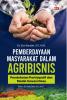
PEMBERDAYAAN MASYARAKAT DALAM AGRIBISNIS: Pendekatan Partisipatif dan Model Inovasi Desa
Kata Kunci:
PEMBERDAYAAN MASYARAKAT, DALAM AGRIBISNIS, Pendekatan PartisipatifSinopsis
Di tengah perubahan sosial-ekonomi yang semakin cepat, mahasiswa agribisnis dan para pemangku kepentingan membutuhkan perspektif baru mengenai bagaimana desa dapat menjadi pusat pertumbuhan ekonomi melalui inovasi dan kemandirian komunitas. Buku ini dirancang untuk menjembatani kesenjangan antara teori pemberdayaan masyarakat dengan praktik nyata yang terjadi di lapangan.
Lebih jauh, buku ajar ini mengangkat konsep-konsep inti seperti partisipasi masyarakat, pembangunan berbasis potensi lokal, pendekatan agribisnis modern, dan model inovasi yang dapat diterapkan secara adaptif di berbagai wilayah Indonesia. Penguatan kapasitas desa bukan sekadar tentang peningkatan produksi pertanian, tetapi tentang bagaimana masyarakat mampu mengelola sumber daya ekonomi, sosial, dan pengetahuan secara mandiri dan berkelanjutan. Oleh karena itu, setiap bab disusun dengan pendekatan analitis, dilengkapi studi kasus, dan dirancang untuk mendorong mahasiswa berpikir kritis, kreatif, serta mampu merumuskan solusi inovatif terhadap persoalan komunitas
Bab
-
KATA PENGANTAR
-
SAMBUTAN EDITOR
-
DAFTAR ISI
-
BAB I SEJARAH PEMBERDAYAAN MASYARAKAT
-
BAB 2 PENGERTIAN PEMBERDAYAAN MASYARAKAT
-
BAB 3 ANALISIS SOSIAL DESA DAN PEMETAAN POTENSI LOKAL
-
BAB 4 PARTISIPASI MASYARAKAT DAN DINAMIKA SOSIAL DESA
-
BAB 5 METODE DAN TEKNIK PEMBERDAYAAN MASYARAKAT
-
BAB 6 KELEMBAGAAN DESA DAN AGRIBISNIS
-
BAB 7 INOVASI DAN TEKNOLOGI DALAM AGRIBISNIS DESA
-
BAB 8 PENGEMBANGAN USAHA AGRIBISNIS DESA
-
BAB 9 MERANCANG PROGRAM PEMBERDAYAAN DESA YANG BERDAMPAK
-
BAB I0 TREN PEMBERDAYAAN MASA DEPAN DESA INDONESIA
-
DAFTAR PUSTAKA
-
PROFIL PENULIS
Unduhan
Referensi
ADB. (2020). Rural development and poverty reduction in Southeast Asia. Asian Development Bank.
Agranoff, R., & McGuire, M. (2020). Collaborative public management: New strategies for local governments. Georgetown University Press.
Aker, J. C. (2011). Dial “A” for agriculture: Using information and communication technologies for agricultural extension in developing countries. Agricultural Economics, 42(6), 631–647. https://doi.org/10.1111/j.1574-0862.2011.00534.x
Alsop, R., Bertelsen, M., & Holland, J. (2006). Empowerment in practice: From analysis to implementation. World Bank.
Amri, S. T., & Fatimah. (2023). Strategi pemberdayaan masyarakat dalam mengurangi pengangguran. Social Development Journal.
Andari, R. N., & Ella, S. (2019). Pengembangan model smart rural untuk pembangunan kawasan perdesaan di Indonesia. Jurnal Borneo Administrator, 15(1).
Ansell, C., & Torfing, J. (2021). Public governance as co-creation: A strategy for revitalizing the public sector. Cambridge University Press. https://doi.org/10.1017/97811087 65381
Bandura, A. (2000). Exercise of human agency through collective efficacy. Current Directions in Psychological Science, 9(3), 75–78. https://doi.org/10.1111/1467-8721.00064
Banks, N., & Hulme, D. (2012). The role of NGOs and civil society in development and poverty reduction. World Development, 40(4), 707–718. https://doi.org/10.1016/j.worlddev. 2012.01.007
Bappenas. (2023). Laporan pembangunan desa Indonesia.
Bebbington, A. (1999). Capitals and capabilities: A framework for analyzing peasant viability. World Development, 27(12), 2021–2044. https://doi.org/10.1016/S0305-750X(99)00104-7
Briedenhann, J., & Wickens, E. (2004). Tourism routes as a tool for the economic development of rural areas. Tourism Management, 25(1), 71–79. https://doi.org/10.1016/ S0261-5177(03)00063-3
Cáceres, C., Li, Y., & Hilton, B. (2021). Climate change vulnerability assessment in rural systems. Environmental Modelling & Software. https://doi.org/10.1016/j.envsoft.2021.105058
Chambers, R. (2017). Can we know better? Reflections for development. Practical Action Publishing.
Chambers, R., & Conway, G. (1992). Sustainable rural livelihoods: Practical concepts for the 21st century. IDS.
Cleaver, F. (1999). Paradoxes of participation: Questioning participatory approaches to development. Journal of International Development, 11(4), 597–612. https://doi.org/10.1002/(SICI)1099-1328(199906)11:4<597::AID-JID610>3.0.CO;2-Q
Cornwall, A. (2020). Unpacking participation: Models, meanings and practices. Community Development Journal, 55(2), 269–283. https://doi.org/10.1093/cdj/bsaa012
DFID. (1999). Sustainable livelihoods guidance sheets.
Ellis, F. (2000). Rural livelihoods and diversity in developing countries. Oxford University Press.
FAO. (2021). Transforming food systems for rural prosperity.
FAO. (2023). Agribusiness and value chain development.
Fikriyah, I., Surjono, & Parlindungan, J. (2023). Pemberdayaan masyarakat dalam penataan kawasan wisata sejarah. Universitas Brawijaya.
Flora, C. B., & Flora, J. L. (2013). Rural communities: Legacy and change (4th ed.). Westview Press.
Gittinger, J. P. (2018). Economic analysis of agricultural projects. Johns Hopkins University Press.
Green, G. P., & Haines, A. (2016). Asset building and community development (4th ed.). SAGE Publications.
GSMA. (2019). The digitalisation of agriculture.
Habib, M. A. F. (2021). Kajian teoritis pemberdayaan masyarakat dan ekonomi kreatif. Journal of Islamic Tourism Halal Food Islamic Traveling and Creative Economy, 1(2), 82–110. https://doi.org/10.21274/ar-rehla.v1i2.4778
Heeks, R. (2010). Do information and communication technologies contribute to development? Journal of International Development, 22(5), 625–640. https://doi.org/ 10.1002/jid.1710
Herdiana, D. (2019). Smart village: Pengembangan desa berbasis teknologi. Jurnal IPTEKKOM.
Ife, J. (1995). Community development: Creating community alternatives—Vision, analysis and practice. Longman.
Ife, J., & Tesoriero, F. (2008). Community development: Community-based alternatives in an age of globalization. Pearson.
Kabeer, N. (1999). Resources, agency, achievements: Reflections on the measurement of women’s empowerment. Development and Change, 30(3), 435–464. https://doi.org/10.1111/ 1467-7660.00125
Klerkx, L., Jakku, E., & Labarthe, P. (2019). A review of social science on digital agriculture. Agricultural Systems. https://doi.org/10.1016/j.agsy.2019.102763
Korten, D. C. (1984). People-centered development: Toward a framework. Public Administration Review, 44(4), 300–308.
Kretzmann, J. P., & McKnight, J. L. (1993). Building communities from the inside out: A path toward finding and mobilizing a community’s assets. ACTA Publications.
Lane, B., & Kastenholz, E. (2015). Rural tourism: The evolution of practice and research. Journal of Sustainable Tourism, 23(8–9), 1133–1156. https://doi.org/10.1080/09669582.2015. 1083997
Laverack, G. (2006). Improving health outcomes through community empowerment. Health Promotion International, 21(1), 63–70.
Mansuri, G., & Rao, V. (2013). Localizing development: Does participation work? World Bank.
Mathie, A., & Cunningham, G. (2003). From clients to citizens: Asset-based community development. Development in Practice, 13(5), 474–486.
OECD. (2021). Rural development policy.
Ostrom, E. (1990). Governing the commons: The evolution of institutions for collective action. Cambridge University Press.
Pretty, J. N. (1995). Participatory learning for sustainable agriculture. World Development, 23(8), 1247–1263.
Prijono, O. S., & Pranarka, A. M. W. (1996). Pemberdayaan: Konsep, kebijakan, dan implementasi. CSIS.
Putnam, R. D. (1993). Making democracy work: Civic traditions in modern Italy. Princeton University Press.
Rappaport, J. (1981). In praise of paradox: A social policy of empowerment. American Journal of Community Psychology, 9(1), 1–25.
Rizkhy, M. A. N., et al. (2022). Pemberdayaan masyarakat mengenai geowisata. Focus: Jurnal Pekerjaan Sosial, 5(1).
Safitri, W. P. F., & Purwanto, D. (2025). Pemberdayaan masyarakat melalui Festival Jerami Purba Sangiran. Jurnal Pemberdayaan Masyarakat, 13(1).
Scheyvens, R. (2002). Tourism for development: Empowering communities. Pearson.
Scoones, I. (1998). Sustainable rural livelihoods: A framework for analysis. IDS.
Sujianto, S., et al. (2023). Pemberdayaan masyarakat desa melalui pengembangan potensi lokal. Jurnal Pengabdian kepada Masyarakat Nusantara, 5(4).
UNDP. (2020). Human development report 2020.
UNICEF. (2021). Community engagement: Strategy and guidelines.
United Nations. (n.d.). Community development: Definition and practice.
Widayanti, S. (2012). Pemberdayaan masyarakat: Pendekatan teoritis. Welfare Journal, 1(1).
World Bank. (2001). World development report 2000/2001: Attacking poverty.
World Bank. (2021). Digital agriculture transformation.
Zhang, N., Wang, M., & Wang, N. (2002). Precision agriculture: A worldwide overview. Computers and Electronics in Agriculture, 36(2–3), 113–132.
Zimmerman, M. A. (2000). Empowerment theory: Psychological, organizational, and community levels of analysis. In J. Rappaport & E. Seidman (Eds.), Handbook of community psychology (pp. 43–63). Boston, MA: Springer.
Zubaedi. (2013). Pengembangan masyarakat: Wacana dan praktik. Kencana.