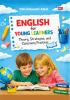
ENGLISH FOR YOUNG LEARNERS: Theory, Strategies, and Classroom Practices
Kata Kunci:
ENGLISH FOR YOUNG LEARNERSSinopsis
Teaching English to young learners is both a challenging and rewarding endeavour. Young learners are curious, imaginative, and highly responsive to engaging and meaningful learning experiences. Recognizing the unique needs of children, this book, English for Young Learners: Theory, Strategies, and Classroom Practices, aims to provide a comprehensive guide for pre-service teachers, teacher trainees, and educators who wish to develop effective English language teaching skills for children.
This book integrates foundational theories of language acquisition, child development, and pedagogical approaches with practical strategies for the classroom. Covering topics such as listening, speaking, reading, and writing, as well as the use of songs, games, storytelling, and digital media, each chapter combines theory with examples of classroom practices to enhance understanding and application.
Designed in alignment with Outcome-Based Education (OBE) principles and Course Learning Outcomes (CPL–CPMK), this textbook emphasizes reflective teaching, microteaching practice, and authentic assessment. It is intended as a resource to inspire creativity, foster learner-centered instruction, and equip future teachers with the confidence and competence to teach English effectively to young learners.
Bab
-
PREFACE
-
CONTENTS
-
CHAPTER 01 INTRODUCTION TO ENGLISH FOR YOUNG LEARNERS (EYL)
-
CHAPTER 02 CHARACTERISTICS OF YOUNG LEARNERS
-
CHAPTER 03 THEORIES OF LANGUAGE ACQUISITION
-
CHAPTER 04 CHILD DEVELOPMENT AND LEARNING
-
CHAPTER 05 CURRICULUM AND SYLLABUS DESIGN FOR EYL
-
CHAPTER 06 TEACHING LISTENING TO YOUNG LEARNERS
-
CHAPTER 07 TEACHING SPEAKING TO YOUNG LEARNERS
-
CHAPTER 08 TEACHING VOCABULARY AND GRAMMAR IN CONTEXT
-
CHAPTER 09 NTEACHING READING AND WRITING FOR YOUNG LEARNERS
-
CHAPTER 10 SONGS, GAMES, AND PLAY-BASED LEARNING
-
CHAPTER 11 STORYTELLING AND CHILDREN’S LITERATURE
-
CHAPTER 12 MEDIA AND TECHNOLOGY IN EYL
-
CHAPTER 13 CLASSROOM MANAGEMENT AND ASSESSMENT
-
CHAPTER 14 MICROTEACHING AND PROFESSIONAL REFLECTION
-
REFERENCES
-
ATTACHEMENT
-
AUTHOR
Unduhan
Referensi
Abel, Chistiyanti, 2025. English for Science and Technology. Penerbit KBM Indonesia.
Allen, D. W., & Ryan, K. (1969). Microteaching. Reading, MA: Addison-Wesley.
American Academy of Pediatrics. (2016). Media and Young Minds. Pediatrics, 138(5), 1–6.
Asher, J. J. (1977). Learning another language through actions. Los Gatos, CA: Sky Oaks Productions.
Brewster, J., Ellis, G., & Girard, D. (2002). The primary English teacher’s guide. Harlow: Pearson Education.
Brown, H. D. (2007). Principles of language learning and teaching. New York: Pearson Education.
Bruner, J. S. (1986). Actual minds, possible worlds. Harvard University Press.
Cameron, L. (2001). Teaching languages to young learners. Cambridge: Cambridge University Press.
Celce-Murcia, M., Brinton, D. M., & Goodwin, J. M. (2010). Teaching pronunciation: A course book and reference guide(2nd ed.). Cambridge University Press.
Chomsky, N. (1965). Aspects of the Theory of Syntax. Cambridge, MA: MIT Press.
Clay, M. M. (1991). Becoming Literate: The Construction of Inner Control. Auckland: Heinemann.
Curtain, H., & Dahlberg, C. A. (2016). Languages and children: Making the match (5th ed.). Boston: Pearson.
Deci, E. L., & Ryan, R. M. (2000). Intrinsic and extrinsic motivations. Contemporary Educational Psychology, 25(1), 54–67.
Dunn, R., & Dunn, K. (1993). Teaching Secondary Students through Their Individual Learning Styles. Boston: Allyn & Bacon.
Ellis, R. (2003). Task-Based Language Learning and Teaching. Oxford: Oxford University Press.
Ellis, R. (2008). The study of second language acquisition (2nd ed.). Oxford: Oxford University Press.
Ellis, G., & Brewster, J. (2014). Tell it again! The storytelling handbook for primary English language teachers. London: British Council.
Farrell, T. S. C. (2015). Promoting teacher reflection in second language education. New York: Routledge.
Gardner, H. (2011). Frames of mind: The theory of multiple intelligences. New York: Basic Books.
Garton, A., & Pratt, C. (1998). Learning to Be Literate: The Development of Spoken and Written Language. Oxford: Blackwell.
Gibbons, P. (2015). Scaffolding language, scaffolding learning (2nd ed.). Portsmouth, NH: Heinemann.
Harmer, J. (2007). How to teach English. Harlow: Pearson Education.
Harmer, J. (2015). The practice of English language teaching (5th ed.). Harlow: Pearson Education.
Krashen, S. D. (1985). The Input Hypothesis: Issues and Implications. London: Longman.
Krashen, S. D. (1982). Principles and Practice in Second Language Acquisition. Oxford: Pergamon Press.
Lightbown, P. M., & Spada, N. (2013). How Languages Are Learned (4th ed.). Oxford: Oxford University Press.
McKay, P. (2006). Assessing young language learners. Cambridge: Cambridge University Press.
Moon, J. (2000). Children learning English. Oxford: Macmillan Heinemann.
Murphey, T. (1992). Music and song. Oxford: Oxford University Press.
Musthafa, B. (2010). Teaching English to young learners in Indonesia: Essential requirements. Educationist, 4(2), 120–125.
Nation, I. S. P., & Newton, J. (2009). Teaching ESL/EFL listening and speaking. New York: Routledge.
Nation, I. S. P. (2001). Learning vocabulary in another language. Cambridge: Cambridge University Press.
Nunan, D. (2011). Definition and characteristics of young learners — young learners are typically children from approximately 3 to 15 years old. Etheses UIN Syekh Wasil Kediri
Paul, D. (2003). Teaching English to children in Asia. Hong Kong:
Piaget, J. (1952). The origins of intelligence in children. New York: International Universities Press.
Pinter, A. (2017). Teaching young language learners. Oxford: Oxford University Press.
Richards, J. C. (2015). Key issues in language teaching. Cambridge: Cambridge University Press.
Richards, J. C., & Lockhart, C. (1996). Reflective teaching in second language classrooms. Cambridge: Cambridge University Press.
Richards, J. C. (2017). Curriculum development in language teaching (2nd ed.). Cambridge University Press.
Rost, M. (2011). Teaching and researching listening (2nd ed.). Harlow: Pearson.
Scott, W. A., & Ytreberg, L. H. (1990). Teaching English to children. London: Longman.
Schön, D. A. (1983). The reflective practitioner. New York: Basic Books.
Shin, J. K., & Crandall, J. (2014). Teaching Young Learners English: From Theory to Practice. Boston: National Geographic Learning.
Skinner, B. F. (1957). Verbal Behavior. New York: Appleton-Century-Crofts.
Slattery, M., & Willis, J. (2001). English for primary teachers. Oxford: Oxford University Press.
Suyanto, K. E. (2007). English for Young Learners: Melejitkan Potensi Anak melalui English Class yang Fun, Asyik, dan Menarik. Jakarta: Bumi Aksara.
Tomlinson, B. (2011). Materials development in language teaching (2nd ed.). Cambridge: Cambridge University Press.
Tompkins, G. E. (2013). Literacy for the 21st century. Boston: Pearson.
UNESCO. (2015). Global Citizenship Education: Topics and Learning Objectives. Paris: UNESCO.
UNESCO. (2018). ICT in education: A critical literature review and its implications. Paris: UNESCO.
Vygotsky, L. S. (1978). Mind in society: The development of higher psychological processes. Cambridge, MA: Harvard University Press.
Wallace, M. J. (1991). Training Foreign Language Teachers: A Reflective Approach. Cambridge: Cambridge University Press.
Wood, E., & Attfield, J. (2005). Play, Learning and the Early Childhood Curriculum. London: Paul Chapman Publishing.
Wright, A., Betteridge, D., & Buckby, M. (2006). Games for language learning (3rd ed.). Cambridge: Cambridge University Press.
Wright, A. (1995). Storytelling with children. Oxford: Oxford University Press.
Wright, A. (1989). Pictures for Language Learning. Cambridge: Cambridge University Press.
Yopp, H. K., & Yopp, R. H. (2000). Supporting Phonemic Awareness Development. Reading Teacher, 54(2), 130–143.