
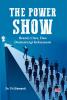
THE POWER SHOW: BRAND, CITRA, DAN DRAMATURGI KEKUASAAN
Keywords:
POWER, SHOWSynopsis
The Power Show: Brand, Citra, Dan Dramaturgi Kekuasaan adalah sebuah karya yang mengupas secara kritis bagaimana kekuasaan dalam dunia politik, khususnya di Indonesia, tidak hanya dijalankan melalui kebijakan dan keputusan, tetapi juga melalui pertunjukan, pencitraan, dan simbolisme. Buku ini membongkar dinamika kekuasaan sebagai sebuah panggung besar, di mana para pemimpin dan aktor politik memainkan peran, memanfaatkan media, dan membangun citra demi memperoleh serta mempertahankan legitimasi.
Berangkat dari teori dramaturgi Erving Goffman hingga studi komunikasi politik kontemporer, buku ini menguraikan bagaimana branding politik, simbol, ritual kenegaraan, hingga mitologi pemimpin menjadi instrumen penting dalam mengonstruksi realitas politik. Pembaca diajak menelusuri perjalanan panjang politik Indonesia sejak era Soekarno, masa Orde Baru, Reformasi, hingga era digital yang ditandai dengan dominasi media sosial, algoritma, dan fenomena viral.
Buku ini tidak hanya menawarkan deskripsi, tetapi juga analisis kritis mengenai risiko politik pencitraan, seperti munculnya populisme dangkal, kultus individu, hingga manipulasi informasi melalui propaganda, hoaks, dan spin doctor. Lebih jauh, buku ini mengajukan refleksi mendalam tentang etika komunikasi politik serta masa depan kekuasaan di tengah perkembangan teknologi seperti kecerdasan buatan, big data, dan deepfake.
Dengan menyajikan studi kasus dari Indonesia dan dunia, buku ini relevan bagi mahasiswa, peneliti, akademisi, jurnalis, praktisi politik, dan masyarakat umum yang ingin memahami bagaimana kekuasaan bekerja di balik layar dan bagaimana pertunjukan politik membentuk persepsi publik. Pada akhirnya, The Power Show menantang kita untuk menjawab pertanyaan mendasar: apakah kekuasaan sesungguhnya masih tentang substansi, ataukah ia telah sepenuhnya menjadi sebuah pertunjukan?
Chapters
-
KATA PENGANTAR
-
DAFTAR ISI
-
BAB – 01 - KEKUASAAN SEBAGAI PERTUNJUKAN
-
BAB – 02 - DRAMATURGI KEKUASAAN
-
BAB – 03 - DRAMATURGI KEKUASAAN
-
BAB – 04 - MEDIA SEBAGAI PANGGUNG KEKUASAAN
-
BAB – 05 - MEDIA SEBAGAI PANGGUNG KEKUASAAN
-
BAB – 06 - DRAMATURGI KEKUASAAN DI INDONESIA
-
BAB – 07 - ETIKA, MANIPULASI, DAN MASA DEPAN KEKUASAAN
-
DAFTAR PUSTAKA
-
PROFIL PENULIS
Downloads
References
Alexander, J. C. (2010). The Performance of Politics: Obama’s Victory and the Democratic Struggle for Power. Oxford: Oxford University Press.
Aspinall, E., & Mietzner, M. (2014). Indonesian politics in 2014: Democracy’s close call. Bulletin of Indonesian Economic Studies, 50(3), 347–369.
Bennett, W. L., & Livingston, S. (2018). The Disinformation Order: Disruptive Communication and the Decline of Democratic Institutions. European Journal of Communication, 33(2), 122–139.
Blumler, J. G., & Kavanagh, D. (1999). The third age of political communication: Influences and features. Political Communication, 16(3), 209–230.
Castells, M. (2009). Communication Power. Oxford: Oxford University Press.
Chadwick, A. (2013). The Hybrid Media System: Politics and Power. Oxford: Oxford University Press.
Corner, J., & Pels, D. (2003). Media and the Restyling of Politics: Consumerism, Celebrity and Cynicism. London: Sage.
Couldry, N. (2003). Media Rituals: A Critical Approach. London: Routledge.
Curran, J. (2011). Media and Democracy. London: Routledge.
Dahl, R. A. (1989). Democracy and Its Critics. New Haven: Yale University Press.
Downing, J. (2001). Radical Media: Rebellious Communication and Social Movements. Thousand Oaks: Sage.
Edelman, M. (1988). Constructing the Political Spectacle. Chicago: University of Chicago Press.
Entman, R. M. (1993). Framing: Toward clarification of a fractured paradigm. Journal of Communication, 43(4), 51–58.
Fairclough, N. (2000). New Labour, New Language?. London: Routledge.
Foucault, M. (1991). Discipline and Punish: The Birth of the Prison. London: Penguin.
Freedman, D. (2014). The Contradictions of Media Power. London: Bloomsbury.
Freire, P. (2005). Pedagogy of the Oppressed. New York: Continuum.
Goffman, E. (1959). The Presentation of Self in Everyday Life. New York: Doubleday.
Habermas, J. (1984). The Theory of Communicative Action, Vol. 1: Reason and the Rationalization of Society. Boston: Beacon Press.
Hall, S. (1997). Representation: Cultural Representations and Signifying Practices. London: Sage.
Herman, E. S., & Chomsky, N. (1988). Manufacturing Consent: The Political Economy of the Mass Media. New York: Pantheon.
Jenkins, H., Ito, M., & Boyd, D. (2016). Participatory Culture in a Networked Era. Cambridge: Polity Press.
Kellner, D. (2016). Media spectacle and the crisis of democracy. Cultural Politics, 12(2), 159–176.
Lakoff, G. (2004). Don’t Think of an Elephant! Know Your Values and Frame the Debate. White River Junction: Chelsea Green.
Lippmann, W. (1922). Public Opinion. New York: Harcourt, Brace and Company.
Loader, B. D., & Mercea, D. (2012). Social Media and Democracy: Innovations in Participatory Politics. London: Routledge.
Manheim, J. B. (2011). Strategy in Information and Influence Campaigns: How Policy Advocates, Social Movements, Insurgent Groups, and Corporations Shape the Debate. London: Routledge.
McChesney, R. (2013). Digital Disconnect: How Capitalism Is Turning the Internet Against Democracy. New York: The New Press.
Meyer, T. (2002). Media Democracy: How the Media Colonize Politics. Cambridge: Polity Press.
Mudde, C., & Rovira Kaltwasser, C. (2017). Populism: A Very Short Introduction. Oxford: Oxford University Press.
Norris, P. (2000). A Virtuous Circle: Political Communications in Postindustrial Societies. Cambridge: Cambridge University Press.
Norris, P., & Inglehart, R. (2019). Cultural Backlash: Trump, Brexit, and Authoritarian Populism. Cambridge: Cambridge University Press.
Ott, B. L. (2017). The age of Twitter: Donald J. Trump and the politics of debasement. Critical Studies in Media Communication, 34(1), 59–68.
Pariser, E. (2011). The Filter Bubble: What the Internet Is Hiding from You. New York: Penguin.
Postman, N. (1985). Amusing Ourselves to Death: Public Discourse in the Age of Show Business. New York: Penguin.
Schlesinger, A. M. (2003). The Politics of Upheaval: 1935–1936, The Age of Roosevelt. Boston: Houghton Mifflin.
Silverstone, R. (2007). Media and Morality: On the Rise of the Mediapolis. Cambridge: Polity Press.
Strömbäck, J., & Esser, F. (2014). Mediatization of politics: Towards a theoretical framework. In Mediatization of Politics (pp. 3–28). London: Palgrave Macmillan.
Sunstein, C. R. (2017). #Republic: Divided Democracy in the Age of Social Media. Princeton: Princeton University Press.
Thompson, J. B. (1995). The Media and Modernity: A Social Theory of the Media. Cambridge: Polity Press.
Tufekci, Z. (2017). Twitter and Tear Gas: The Power and Fragility of Networked Protest. New Haven: Yale University Press.
van Dijck, J., Poell, T., & de Waal, M. (2018). The Platform Society: Public Values in a Connective World. Oxford: Oxford University Press.
Wardle, C., & Derakhshan, H. (2017). Information Disorder: Toward an Interdisciplinary Framework for Research and Policy Making. Strasbourg: Council of Europe.
Weber, M. (1947). The Theory of Social and Economic Organization. New York: Free Press.
Williams, R. (1974). Television: Technology and Cultural Form. London: Routledge.
Downloads
Published
License

This work is licensed under a Creative Commons Attribution-ShareAlike 4.0 International License.