
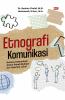
ETNOGRAFI KOMUNIKASI: Nuansa Komunikasi dalam Ranah Budaya dan Kearifan Lokal
Keywords:
etnografi, komunikasi, budayaSynopsis
Latar belakang penulisan buku Etnografi Komunikasi: Nuansa Komunikasi dalam Ranah Budaya dan Kearifan Lokal ini berangkat dari kebutuhan untuk memperdalam pemahaman tentang etnografi komunikasi sebagai pendekatan yang kaya akan konteks budaya dan sosial. Melalui buku ini, penulis ingin menyajikan gambaran komprehensif mengenai konsep, metodologi, dan aplikasi etnografi komunikasi dalam berbagai aspek kehidupan masyarakat, khususnya dalam konteks Indonesia yang kaya akan kearifan lokal.
Tujuan utama dari penulisan buku ini adalah untuk memberikan referensi yang mudah dipahami bagi mahasiswa, peneliti, dan praktisi komunikasi serta antropologi yang ingin mendalami studi etnografi komunikasi secara mendalam. Ruang lingkup materi mencakup teori dasar, metodologi, serta studi kasus yang relevan, sehingga dapat memperkaya wawasan pembaca tentang praktik komunikasi dalam berbagai komunitas dan budaya. Saya berharap buku ini dapat menjadi sumber belajar yang bermanfaat dan mendorong pengembangan studi etnografi komunikasi di Indonesia dan dunia
Chapters
-
PRAKATA
-
KATA PENGANTAR
-
DAFTAR ISI
-
PROLOG
-
BAB 1 PENGANTAR ETNOGRAFI KOMUNIKASI
-
BAB 2 NUANSA KOMUNIKASI DALAM RANAH KEARIFAN LOKAL
-
BAB 3 PARADIGMA DAN PENDEKATAN TEORETIS
-
BAB 4 KONSEP DASAR DALAM ETNOGRAFI KOMUNIKASI
-
BAB 5 METODOLOGI PENELITIAN ETNOGRAFI KOMUNIKASI
-
BAB 6 MODEL ANALISIS SPEAKING DARI DELL HYMES
-
BAB 7 BAHASA, KEKUASAAN, DAN IDENTITAS
-
BAB 8 PRAKTIK KOMUNIKASI DALAM KOMUNITAS ADAT
-
BAB 9 KOMUNIKASI GENDER DALAM PERSPEKTIF ETNOGRAFI
-
BAB 10 KOMUNIKASI GENERASI DIGITAL
-
BAB 11 ETNOGRAFI KOMUNIKASI DALAM DUNIA PENDIDIKAN
-
BAB 12 KOMUNIKASI ANTARBUDAYA DAN GLOBALISASI
-
BAB 13 KOMUNIKASI RELIGIUS DAN SIMBOLISME
-
BAB 14 KOMUNIKASI POLITIK DAN WACANA PUBLIK
-
BAB 15 HUMOR DAN KOMUNIKASI DALAM BUDAYA LOKAL
-
BAB 16 ISU ETIKA DALAM PENELITIAN ETNOGRAFI
-
BAB 17 TREN DAN MASA DEPAN ETNOGRAFI KOMUNIKASI
-
EPILOG
-
REFERENSI
-
BIOGRAFI PENULIS
Downloads
References
1. Aristotle. (2007). Rhetoric (W. Rhys Roberts, Trans.). Oxford University Press. (Original work published ca. 384–322 BC).
2. Attardo, S. (2014). Linguistic theories of humor. Springer.
3. Bastos, M., & Mercea, D. (2019). The networked public sphere: Social media and the public debate. New Media & Society, 21(7), 1555–1574.
4. Beauchamp, T. L., & Childress, J. F. (2013). Principles of biomedical ethics (7th ed.). Oxford University Press.
5. Billig, M. (2005). Laughter and ridicule: Towards a social critique of humor. Sage Publications.
6. Bishop, B., & Walker, J. (2019). The social impact of #MeToo: A digital ethnography. Journal of Digital Culture, 12(3), 45–62.
7. Bourdieu, P. (1991). Language and symbolic power. Harvard University Press.
8. Butler, J. (1990). Gender trouble: Feminism and the subversion of identity. Routledge.
9. Castells, M. (2010). The rise of the network society (2nd ed.). Wiley-Blackwell.
10. Dell Hymes. (1974). Foundations in sociolinguistics: An ethnographic approach. University of Pennsylvania Press.
11. Durkheim, É. (1995). The elementary forms of religious life (K. E. Fields, Trans.). Free Press. (Original work published 1912). https://doi.org/10.4324/9781315686444
12. Foucault, M. (1972). The archaeology of knowledge. Routledge.
13. Foucault, M. (2010). Discipline and punish: The birth of the prison. Vintage Books.
14. Goffman, E. (1959). The presentation of self in everyday life. Anchor Books.
15. Geertz, C. (1973). The interpretation of cultures. Basic Books.
16. Geertz, C. (1973). The interpretation of cultures. Basic Books.
17. Gumperz, J. J., & Hymes, D. (2019). Directions in sociolinguistics: The ethnography of communication. Wiley-Blackwell.
18. Gumperz, J. J. (1982). Discourse strategies. Cambridge University Press.
19. Hall, S. (1997). The work of representation. In Representation: Cultural representations and signifying practices (pp. 13–74). Sage Publications.
20. Hammersley, M., & Atkinson, P. (2007). Ethnography: Principles in practice (3rd ed.). Routledge.
21. Hammersley, M., & Traianou, A. (2012). Ethics and educational research. Bloomsbury Publishing.
22. Heryanto, D. (2018). Kearifan lokal dan harmoni sosial: Studi etnografi komunikasi. Gramedia.
23. Hine, C. (2015). Ethnography for the internet: Embedded, embodied and everyday. Bloomsbury Academic.
24. Hinton, L., & Hale, K. (Eds.). (2013). The green book of language revitalization in practice. Academic Press.
25. Hirsch, P., & Smith, J. (2018). Communication practices among coastal fishermen: A field study. Journal of Ethnographic Communication, 12(3), 245–267.
26. Hymes, D. (1962). The ethnography of speaking. Anthropological Linguistics, 4(2), 1–25.
27. Hymes, D. (1962). The ethnography of speaking. In T. Gladwin & W. Sturtevant (Eds.), Language and culture (pp. 13–53). Holt, Rinehart & Winston.
28. Hymes, D. (1974). Foundations in sociolinguistics: An ethnographic approach. University of Pennsylvania Press.
29. Hymes, D. (1996). Ethnography, linguistics, narrative inequality: Toward an understanding of voice. Taylor & Francis.
30. Kress, G., & van Leeuwen, T. (2001). Multimodal discourse: The modes and media of contemporary communication. Routledge.
31. Kvale, S., & Brinkmann, S. (2009). Interviews: Learning the craft of qualitative research interviewing (2nd ed.). Sage Publications.
32. Klein, J. T. (2010). Creating interdisciplinary campus cultures: A model for strengthening the academic mission. John Wiley & Sons.
33. Klein, J. T. (2010). Creating Interdisciplinary Campus Cultures: A Model for Strengthening the Academic Mission. John Wiley & Sons.
34. Kumar, S. (2018). Mantras and rituals in Hinduism: A cultural perspective. Journal of Religious Studies, 45(2), 123–135.
35. Kumar, S., Singh, R., & Singh, S. (2020). Analyzing social media data for understanding public sentiment during COVID-19 pandemic. Journal of Data Science, 18(4), 567–582.
36. Labov, W. (2010). Principles of linguistic change, volume 2: Social factors. Wiley-Blackwell.
37. Laclau, E., & Mouffe, C. (1985). Hegemony and socialist strategy: Towards a radical democratic politics. Verso.
38. Liamputtong, P. (2010). Research methods in health: Foundations for evidence-based practice. Oxford University Press.
39. Liamputtong, P. (2019). Research methods in health: Foundations for evidence-based practice. Oxford University Press.
40. Liu, B. (2012). Sentiment analysis and opinion mining. Synthesis Lectures on Human Language Technologies, 5(1), 1–167.
41. Liu, S., & Zhang, J. (2020). Multidisciplinary approaches to social media research: A review. Social Media + Society, 6(2), 205630512092585.
42. Luntz, F. (2007). Words that work: It's not what you say, it's what people hear. Hyperion.
43. Margetts, H., et al. (2019). Political disinformation and online influence campaigns: The role of social media. Nature Human Behaviour, 3(10), 1074–1079.
44. McLuhan, M. (1964). Understanding media: The extensions of man. McGraw-Hill.
45. Pink, S. (2013). Doing visual ethnography. Sage Publications.
46. Pink, S. (2015). Doing visual ethnography (3rd ed.). Sage Publications.
47. Purnama, R., & Suryadi, D. (2020). Praktik komunikasi dalam komunitas adat: Studi etnografi. Jurnal Komunikasi dan Budaya, 15(2), 123–138.
48. Saldaña, J. (2016). The coding manual for qualitative researchers (3rd ed.). Sage Publications.
49. Searle, J. R. (1969). Speech acts: An essay in the philosophy of language. Cambridge University Press.
50. Silverman, D. (2016). Qualitative research (4th ed.). Sage Publications.
51. Sneddon, J. N. (2015). The languages of Indonesia: A comprehensive guide. Routledge.
52. Spradley, J. P. (1979). The ethnographic interview. Holt, Rinehart and Winston.
53. Spradley, J. P. (2016). Participant observation. Waveland Press.
54. Suryadi, A., & Suryani, R. (2020). The role of local wisdom in maintaining social harmony: A case study. Journal of Cultural Studies, 15(2), 123–138.
55. Tajfel, H., & Turner, J. C. (1979). An integrative theory of intergroup conflict. In W. G. Austin & S. Worchel (Eds.), The social psychology of intergroup relations (pp. 33–47). Brooks/Cole.
56. Turner, V. (1969). The ritual process: Structure and anti-structure. Aldine de Gruyter.
57. UNESCO. (2019). Endangered languages. Retrieved from https://en.unesco.org/themes/endangered-languages
58. Van Dijk, T. A. (2011). Discourse studies: A multidisciplinary introduction. SAGE Publications.
59. Z. (2013). The green book of language revitalization in practice. Academic Press.’
Published
License

This work is licensed under a Creative Commons Attribution-ShareAlike 4.0 International License.