
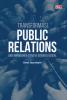
TRANSFORMASI PUBLIC RELATIONS: Dari Manajemen Citra ke Advokasi Sosial
Keywords:
public realtions, manajemen citra, advokasi sosialSynopsis
Di tengah dunia yang sedang gaduh dengan disinformasi, krisis di berbagai sektor, konflik sosial, dan hilangnya kepercayaan terhadap institusi, hadir sebuah buku yang menawarkan arah baru bagi praktik Public Relatinos (PR), Transformasi Public Relations: Dari Manajemen Citra ke Advokasi Sosial. Buku ini adalah pernyataan sikap, ajakan dialog, sekaligus peta jalan menuju masa depan PR yang lebih manusiawi. Alur narasi buku ini dimulai dengan pembahasan PR yang dibentuk oleh paradigma yang mempromosikan harmoni semu, sebuah harmoni yang sering kali menyingkirkan kritik, membungkam suara marjinal, dan menyembunyikan ketidakadilan di balik kata-kata rapi dan kampanye yang memukau. Buku ini tidak hanya berisi krtitik, namun juga menawarkan jalan baru, yaitu PR sebagai aktivisme, PR sebagai empati, PR sebagai jembatan moral yang menautkan organisasi dan masyarakat. PR yang tidak hanya milik dunia korporasi, namun juga milik warga, komunitas, gerakan sosial, dan bahkan siapa pun yang ingin memperjuangkan dunia yang lebih adil.
Dalam buku ini, pembaca akan diajak untuk berpikir tentang paradigma PR lama yang semakin kehilangan relevansi, tentang PR simetris yang tidak pernah benar-benar simetris, tentang kekuasaan yang bekerja di balik narasi publik hanya untuk membentuk citra, serta tentang PR yang pada akhirnya bertransformasi menjadi praktik dialogis, etis, dan mengambil peran advokasi. Narasinya mengalir, lugas, dan membuka mata, terutama bagi para praktisi PR yang sedang mencari arah baru di tengah arus perubahan. Melalui beberapa pemaparan tentang studi kasus, pembaca melihat bahwa PR juga memiliki kekuatan untuk menggerakkan massa, memicu kesadaran, dan memperbaiki kebijakan publik. Inilah PR yang hidup. PR yang tidak hanya bicara, tetapi bertindak. Buku ini mengajak pembaca menyadari bahwa PR yang sejati bukanlah yang paling piawai menyusun pesan, tetapi yang paling tulus mendengarkan. Buku ini bisa menjadi manifestasi moral bagi siapa pun yang bekerja di dunia PR, baik praktisi, akademisi, mahasiswa, jurnalis, aktivis, maupun pemimpin organisasi. Ini bukan sekadar buku. Ini adalah arah baru. Ini adalah PR yang bermakna.
Chapters
-
KATA PENGANTAR
-
DAFTAR ISI
-
PENDAHULUAN
-
BAB 1 WAJAH BARU PUBLIC RELATIONS DI ERA AKTIVISME SOSIAL
-
BAB 2 ACTIVIST PUBLIC RELATIONS: DARI RESISTENSI MENUJU TRANSFORMASI SOSIAL
-
BAB 3 KOMUNIKASI DIALOGIS DAN DEMOKRASI RETORIS DALAM PRAKTIK PUBLIC RELATIONS
-
BAB 4 ETIKA, KEKUASAAN, DAN IDEOLOGI DALAM KOMUNIKASI PUBLIK
-
BAB 5 PUBLIC RELATIONS DAN GERAKAN SOSIAL DIGITAL: STRATEGI KOMUNIKASI DI ERA JARINGAN
-
BAB 6 PUBLIC RELATIONS DAN ADVOKASI SOSIAL: KOMUNIKASI SEBAGAI GERAKAN MORAL
-
BAB 7 COMMUNITY PUBLIC RELATIONS: PRAKTIK KOMUNIKASI EMANSIPATORIS DI INDONESIA
-
BAB 8 KRISIS, SOLIDARITAS, DAN TANGGUNG JAWAB MORAL PUBLIC RELATIONS
-
BAB 9 MASA DEPAN PUBLIC RELATIONS: DARI MANAJEMEN CITRA KE ADVOKASI SOSIAL
-
EPILOG
-
DAFTAR PUSTAKA
-
PROFIL PENULIS
Downloads
References
Banerjee, S. B. (2008). Corporate social responsibility: The good, the bad and the ugly. Critical Sociology, 34(1), 51–79.
Bennett, W. L., & Segerberg, A. (2012). The logic of connective action: Digital media and the personalization of contentious politics. Cambridge University Press.
Botan, C. H., & Taylor, M. (2004). Public relations: State of the field. Journal of Communication, 54(4), 645–661. https://doi.org/10.1111/j.1460-2466.2004.tb02649.x
Breeze, R. (2020). The rhetoric of authenticity in digital activism. Discourse & Society, 31(6), 624–642. https://doi.org/10.1177/0957926520923832
Bucher, T. (2018). If...then: Algorithmic power and politics. Oxford University Press.
Castells, M. (2012). Networks of outrage and hope: Social movements in the internet age. Polity Press.
Choudry, A., & Kapoor, D. (Eds.). (2013). NGOization: Complicity, contradictions and prospects. Zed Books.
Coombs, W. T. (2007). Ongoing crisis communication: Planning, managing, and responding. Sage Publications.
Coombs, W. T., & Holladay, S. J. (2012). The handbook of crisis communication. Wiley-Blackwell.
Couldry, N., & Mejias, U. A. (2019). The costs of connection: How data is colonizing human life and appropriating it for capitalism. Stanford University Press.
Devinatz, V. G. (2008). The labor movement's strategic dilemma. WorkingUSA, 11(2), 219–235.
Dozier, D. M., & Lauzen, M. M. (2000). Liberating the intellectual domain from the practice: Public relations, activism, and the role of theory. Journal of Public Relations Research, 12(1), 3–22. https://doi.org/10.1207/S1532754XJPRR1201_2
Durkheim, É. (1984). The division of labor in society. Free Press. (Original work published 1893)
Dutta, M. J. (2020). Decolonizing communication for social change: A culture-centered approach. Routledge.
Edelman. (2021). 2021 Edelman Trust Barometer. https://www.edelman.com/trust/2021-trust-barometer
Faludi, S. (1991). Backlash: The undeclared war against American women. Crown.
Foucault, M. (1980). Power/knowledge: Selected interviews and other writings (1972–1977). Pantheon Books.
Freire, P. (1970). Pedagogy of the oppressed. Continuum.
Gilligan, C. (1982). In a different voice: Psychological theory and women’s development. Harvard University Press.
Gramsci, A. (1971). Selections from the prison notebooks. International Publishers.Grunig,
J. E. (1992). Excellence in public relations and communication management. Lawrence Erlbaum Associates.
Grunig, J. E., & Hunt, T. (1984). Managing public relations. Holt, Rinehart and Winston.
Grunig, L. A., Grunig, J. E., & Dozier, D. M. (2002). Excellent public relations and effective organizations: A study of communication management in three countries. Lawrence Erlbaum Associates.
Gutmann, A., & Thompson, D. (2012). The spirit of compromise: Why governing demands it and campaigning undermines it. Princeton University Press.
Habermas, J. (1984). The theory of communicative action: Reason and the rationalization of society (Vol. 1). Beacon Press.
Habermas, J. (1990). Moral consciousness and communicative action. MIT Press.
Hadiz, V. R., & Robison, R. (2017). Competing populisms in post-authoritarian Indonesia. International Political Science Review, 38(4), 488–502.
Harsin, J. (2021). The post-truth era: Rhetoric, trust, and digital media. Oxford University Press.
Heath, R. L. (2006). Rhetorical democracy: Advocacy, public relations, and the public sphere. Lawrence Erlbaum Associates.
Heath, R. L. (2006). Onward into more fog: Thoughts on public relations’ research directions. Journal of Public Relations Research, 18(2), 93–114.
Heath, R. L., & Waymer, D. (2020). Dialogic ethics and co-created meaning in public relations. Journal of Public Relations Research, 32(5–6), 167–182. https://doi.org/10.1080/1062726X.2020.1805648
Holtzhausen, D. (2012). Public relations as activism: Postmodern approaches to theory and practice. Routledge.
Holtzhausen, D. (2015). Postmodern values in public relations. In R. L. Heath (Ed.), The SAGE handbook of public relations (2nd ed., pp. 683–696). Sage Publications.
Holtzhausen, D. R. (2000). Postmodern values in public relations. Journal of Public Relations Research, 12(1), 93–114.
Holtzhausen, D. R. (2007). Activism in public relations: Postmodern approaches to theory and practice. Public Relations Review, 33(4), 357–362.
Holtzhausen, D., & Voto, R. (2002). Resistance from the margins: The postmodern public relations practitioner as organizational activist. Journal of Public Relations Research, 14(1), 57–84.
Houston, J. B., et al. (2015). Community resilience and communication: Dynamic interconnections. American Behavioral Scientist, 59(2), 254–273.
Ihlen, Ø., Fredriksson, M., & van Ruler, B. (Eds.). (2009). Public relations and social theory: Key figures and concepts. Routledge.
Jasper, J. M. (1997). The art of moral protest: Culture, biography, and creativity in social movements. University of Chicago Press.
Jenkins, H. (2019). Participatory culture in a networked era. Polity Press.
Jordan, L., & van Tuijl, P. (Eds.). (2006). NGO accountability: Politics, principles and innovations. Earthscan.
Keck, M. E., & Sikkink, K. (1998). Activists beyond borders: Advocacy networks in international politics. Cornell University Press.
Kent, M. L., & Lane, A. B. (2017). A rhizomatic approach to stakeholder theory: Dialogic ethics and communication in public relations. Public Relations Review, 43(4), 568–578.
Kent, M. L., & Taylor, M. (2002). Toward a dialogic theory of public relations. Public Relations Review, 28(1), 21–37. https://doi.org/10.1016/S0363-8111(02)00108-X
Kriyantono, R. (2015). Public relations and corporate social responsibility in mandatory approach era in Indonesia. Procedia - Social and Behavioral Sciences, 211, 320–327.
L’Etang, J. (2008). Public relations: Concepts, practice, and critique. Sage Publications.
Lestari, P., & Arifin, Z. (2021). Crisis communication and community resilience during COVID-19 in Indonesia. Asian Journal of Communication, 31(5), 475–492.
Levinas, E. (1969). Totality and infinity: An essay on exteriority. Duquesne University Press.
Lim, M. (2013). Many clicks but little sticks: Social media activism in Indonesia. Journal of Contemporary Asia, 43(4),636–657. https://doi.org/10.1080/00472336.2013.769386.
Macnamara, J. (2018). Evaluating public communication: Exploring new models, standards, and best practice. Routledge.
Melkote, S. R., & Steeves, H. L. (2015). Communication for development and social change (3rd ed.). Sage Publications.
Motion, J., & Leitch, S. (2020). Discourse, power, and public relations: Beyond persuasion. Public Relations Inquiry, 9(2), 149–168. https://doi.org/10.1177/2046147X20916300.
Motion, J., & Weaver, C. K. (2005). A discourse perspective for critical public relations research: Life sciences network and the battle for truth. Journal of Public Relations Research, 17(1), 49–67.
Nasution, H. (2023). Disaster PR and local wisdom in Indonesian crisis communication. Public Relations Review, 49(2), 102–117.
Nugroho, Y. (2011). Opening the black box: The adoption of innovations in the voluntary sector in Indonesia. Manchester Institute of Innovation Research.
O’Neil, C. (2016). Weapons of math destruction: How big data increases inequality and threatens democracy. Crown Publishing.
Parsons, P. J. (2016). Ethics in public relations: A guide to best practice (2nd ed.). Kogan Page.
Parsons, T. (1951). The social system. Free Press.
Poell, T., Nieborg, D. B., & van Dijck, J. (2019). Platforms and cultural production. Polity Press.
Prasetyawan, Y. (2017). River conservation through community empowerment: A case study of ECOTON in Brantas River restoration. Indonesian Journal of Environment and Sustainable Development, 8(2), 45–58.
Rachman, N. F. (2017). From land reform to agrarian reform: The ongoing struggle for land in Indonesia. In Land and development in Indonesia (pp. 21–44). Springer.
Ricoeur, P. (1992). Oneself as another. University of Chicago Press.
Schultz, F., & Heath, R. L. (2021). The ecological turn in public relations. Public Relations Inquiry, 10(3), 287–306. https://doi.org/10.1177/2046147X211016705.
Seeger, M. W., Sellnow, T. L., & Ulmer, R. R. (2018). Narrative, sensemaking, and crisis communication: Understanding the dynamics of trust. Journal of Applied Communication Research, 46(4), 420–437.
Stohl, C., Etter, M., Banghart, S., & Woo, D. (2017). Social media policies: Implications for contemporary notions of corporate social responsibility. Journal of Business Ethics, 142(3), 413–436.
Syahputra, I. (2020). Digital activism and the #ReformasiDikorupsi movement in Indonesia. Jurnal Komunikasi Indonesia, 9(2), 115–134.
Syahputra, I. (2021). Toxic communication and the moral crisis of digital democracy. Komunikator, 13(1), 45–60.
Taylor, M. (2011). Building social capital through rhetoric and public relations. Management Communication Quarterly, 25(3), 436–454.
Tempo. (2018). Freeport dan kontroversi kontrak tambang: Konflik kepentingan dan komunikasi publik. Tempo Publishing.
Tiesinga, H. (2021). Intersectional solidarity and social movement communication. Social Movement Studies, 20(6), 745–761. https://doi.org/10.1080/14742837.2020.1824752.
Tronto, J. C. (1993). Moral boundaries: A political argument for an ethic of care. Routledge.
Valentini, C. (2022). Reimagining public relations: Toward a critical-global perspective. Public Relations Inquiry, 11(1), 3–21.
Vrasti, W. (2013). Volunteer tourism in the global south: Giving back in neoliberal times. Routledge.
Werder, K. P., & Holtzhausen, D. (2018). Social justice and public relations: New directions in theory and research. Journal of Public Relations Research, 30(1–2), 1–4.
Yulianti, D., & Susanto, E. (2021). Komunikasi kebencanaan berbasis komunitas: Belajar dari Palu. Jurnal Ilmu Komunikasi, 18(1), 45–61.
Published
License

This work is licensed under a Creative Commons Attribution-ShareAlike 4.0 International License.