
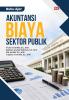
BUKU AJAR AKUNTANSI BIAYA SEKTOR PUBLIK
Keywords:
AKUNTANSI, AKUNTANSI BIAYA, SEKTOR PUBLIKSynopsis
Buku Akuntansi Biaya Sektor Publik disusun sebagai bahan ajar yang membahas konsep, prinsip, dan penerapan akuntansi biaya dalam organisasi sektor publik, seperti pemerintah pusat dan daerah, SKPD, dan unit pelayanan publik lainnya. Buku ini menjelaskan bagaimana biaya layanan publik diidentifikasi, diklasifikasikan, dicatat, dihitung, dialokasikan, dan dianalisis untuk mendukung perencanaan anggaran, penentuan tarif layanan, evaluasi efisiensi, serta pertanggungjawaban kinerja instansi publik. Tujuan pembelajaran dari buku ini adalah agar mahasiswa mampu memahami konsep dasar biaya sektor publik, membedakan biaya langsung dan tidak langsung, biaya tetap dan variabel, menghitung harga pokok layanan publik, menyusun laporan biaya, serta menggunakan informasi biaya untuk pengambilan keputusan manajerial dan kebijakan publik.
Selain uraian teori, buku ini dilengkapi dengan contoh kasus yang relevan dengan kondisi sektor publik. Setiap kasus disusun secara sistematis mulai dari penyajian data biaya, pengelompokan biaya, perhitungan total biaya, perhitungan biaya per unit layanan, hingga analisis efisiensi dan subsidi pemerintah. Untuk memperkuat pemahaman mahasiswa, buku ini juga menyediakan soal latihan dalam bentuk soal pilihan, esai, dan studi kasus yang menuntut kemampuan analisis, perhitungan, serta interpretasi hasil, sehingga mahasiswa tidak hanya memahami teori akuntansi biaya sektor publik, tetapi juga mampu menerapkannya dalam praktik pengelolaan keuangan instansi publik secara transparan, akuntabel, dan berorientasi pada pelayanan masyarakat.
Chapters
-
KATA PENGANTAR
-
DAFTAR ISI
-
BAB 01. PENGANTAR AKUNTANSI BIAYA SEKTOR PUBLIK
-
BAB 02. KLASIFIKASI DAN PERILAKU BIAYA
-
BAB 03. SISTEM PERHITUNGAN BIAYA DALAM LEMBAGA PUBLIK
-
BAB 04. PERHITUNGAN BIAYA LAYANAN PUBLIK
-
BAB 05. ANGGARAN BIAYA SEKTOR PUBLIK
-
BAB 06. PERENCANAAN DAN PENGENDALIAN BIAYA PUBLIK
-
DAFTAR PUSTAKA
-
PROFIL PENULIS
Downloads
References
Adadi, A., & Berrada, M. (2018). Peeking inside the black-box: A survey on explainable artificial intelligence (XAI). IEEE Access, 6, 52138-52160. https://doi.org/10.1109/ ACCESS.2018.2870052
Adhikari, P., & Mellemvik, F. (2011). The rise and fall of accruals: A story of public sector accounting reform. Management Auditing Journal, 26(4), 349–369. https://doi.org/10.1108/02686901111124434
Adler, M. D. (2012). Well-being and fair distribution: Beyond cost-benefit analysis. Oxford University Press.
Adler, M. D., & Posner, E. A. (2006). New foundations of cost-benefit analysis. Harvard University Press.
Adriyani, R., & Syafruddin, M. (2017). Analisis penerapan activity-based costing system dalam penentuan unit cost pada badan layanan umum daerah (BLUD) rumah sakit. Diponegoro Journal of Accounting, 6(3), 1-13.
AGA (Association of Government Accountants). (2022). Citizen-Centric Reporting. https://www.agacgfm.org /ccr.aspx
Agustina, L. D., & Yuliana, I. (2021). Analisis perbandingan unit cost riil dengan tarif INA-CBG’s sebagai dasar pengambilan keputusan di rumah sakit BLUD. Jurnal Akuntansi dan Keuangan, 9(1), 45-58.
Ahmad, N., & Othman, R. (2017). The importance of top management commitment for successful implementation of management control systems. Journal of Accounting and Management Information Systems, 16(2), 249-267.
AICPA. (2019). Not-for-Profit Entities: Audit and Accounting Guide. American Institute of Certified Public Accountants.
Albrecht, W. S., Albrecht, C. O., Albrecht, C. C., & Zimbelman, M. F. (2019). Fraud examination (6th ed.). Cengage Learning.
Alles, M. G., Kogan, A., & Vasarhelyi, M. A. (2008). Putting continuous auditing theory into practice: Lessons from a Fortune 500 company. Journal of Information Systems, 22(2), 1-21.
Anand, S., & Sen, A. (2000). The income component of the human development index. Journal of Human Development, 1(1), 83-106. https://doi.org/10.1080/ 14649880050008782
Andreasen, A. R., & Kotler, P. (2008). Strategic marketing for nonprofit organizations (7th ed.). Pearson Prentice Hall.
Anessi-Pessina, E., & Steccolini, I. (2007). The utility of budget reporting in a context of reform: A case study. Public Money & Management, 27(3), 209-216.
Anessi-Pessina, E., Nasi, G., & Steccolini, I. (2016). Public sector financial management and accounting: The ongoing challenge of grand simplification. Public Money & Management, 36(5), 313-316. https://doi.org/10.1080/09540962.2016.1194073
Anheier, H. K. (2014). Nonprofit organizations: Theory, management, policy (2nd ed.). Routledge.
Annisette, M., Cooper, C., & Gendron, Y. (2021). The public interest and the COVID-19 pandemic: A call to arms for the accounting profession. Critical Perspectives on Accounting, 79, 102244. https://doi.org/10.1016/ j.cpa.2020.102244
Anthony, R. N., & Govindarajan, V. (2007). Management control systems (12th ed.). McGraw-Hill/Irwin.
Anthony, R. N., & Young, D. W. (2003). Management control in nonprofit organizations (7th ed.). McGraw-Hill/Irwin.
Aranya, N., & Ferris, K. R. (1984). A reexamination of accountants' organizational-professional conflict. The Accounting Review, 59(1), 1-15.
Arens, A. A., Elder, R. J., & Beasley, M. S. (2017). Auditing and assurance services: An integrated approach (16th ed.). Pearson.
Arfianti, D., & Martani, D. (2011). Analisis proses penyusunan standar akuntansi pemerintahan di Indonesia. Jurnal Akuntansi dan Keuangan Indonesia, 8(2), 125-144.
Argyris, C. (1977). Organizational learning and management information systems. Accounting, Organizations and Society, 2(2), 113-123. https://doi.org/10.1016/0361-3682(77)90014-X
Armitage, H. M., & Nicholson, R. (1993). Activity-based costing: A management tool. CMA Magazine, 67(2), 23-27.
Arrow, K. J., Cropper, M. L., Gollier, C., Groom, B., Heal, G. M., Newell, R. G., ... & Weitzman, M. L. (2013). How should benefits and costs be discounted in an intergenerational context? The views of an expert panel. Review of Environmental Economics and Policy, 7(2), 1-18. https://doi.org/10.1093/reep/ret005
Asiedu, Y., & Gu, P. (1998). Product life cycle cost analysis: A model for the structure of choices. Journal of Engineering Design, 9(3), 265-276. https://doi.org/10.1080/09544829808907987
Ashari, A., & Tjahjono, M. E. (2018). Analisis faktor-faktor penyebab cost overrun pada proyek konstruksi gedung di Indonesia. Jurnal Manajemen Teknologi, 17(1), 54-69.
Aulia, Z. F., & Rokhim, R. (2021). Penerapan anggaran berbasis kinerja pada pemerintah daerah: Sebuah tinjauan sistematis. Jurnal Akuntansi dan Keuangan Daerah, 16(1), 1-18.
Azhari, F., & Setyaningrum, D. (2022). Pengaruh pusat pertanggungjawaban sebagai alat pengendalian manajemen terhadap kinerja manajerial. Jurnal Riset Akuntansi Dan Keuangan, 10(1), 123–134. https://doi.org/10.21460/jrak.2022.101.378
Baker, J. J., & Hogan, T. (2018). Healthcare finance: An introduction to accounting and financial management (6th ed.). Health Administration Press.
Baker, J. J., & Taylor, S. L. (1997). A model for determining the cost of health care services in a hospital setting. Journal of Health Care Finance, 23(4), 1-16.
Ball, A., & Grubnic, S. (2007). Sustainability accounting and accountability in the public sector. In J. Unerman, J. Bebbington, & B. O'Dwyer (Eds.), Sustainability accounting and accountability (pp. 243-265). Routledge.
Bappenas. (2017). Pedoman Penyusunan Rencana Pembangunan Jangka Menengah Daerah (RPJMD) 2015-2019. Kementerian Perencanaan Pembangunan Nasional/Bappenas.
Bast, M. E. (2021). The impact of activity-based costing on tuition fees in Indonesian public universities. Journal of Applied Research in Higher Education, 13(2), 430-445. https://doi.org/10.1108/JARHE-05-2020-0136
Bastian, I. (2010). Akuntansi sektor publik: Suatu pengantar. Erlangga.
Baumol, W. J. (1972). On taxation and the control of externalities. The American Economic Review, 62(3), 307-322.
Bebbington, J., & Unerman, J. (2018). Achieving the United Nations Sustainable Development Goals: An enabling role for accounting research. Accounting, Auditing & Accountability Journal, 31(1), 2-24. https://doi.org/ 10.1108/AAAJ-05-2017-2929
Bebbington, J., Larrinaga, C., & Moneva, J. M. (2001). Corporate social reporting and reputation risk management. Accounting, Auditing & Accountability Journal, 14(3), 337-356.
Behn, R. D. (2003). Why measure performance? Different purposes require different measures. Public Administration Review, 63(5), 586-606. https://doi.org/10.1111/1540-6210.00322
Berger, R. (2012). The nonprofit overhead cost debate. The CPA Journal, 82(11), 6-11.
Bjørnenak, T., & Mitchell, F. (2002). The relevance of activity-based costing in the public sector. In A. Lapsley & F. Mitchell (Eds.), Accounting and accountability in the new public sector (pp. 191-208). Routledge.
Boardman, A. E., Greenberg, D. H., Vining, A. R., & Weimer, D. L. (2018). Cost-benefit analysis: Concepts and practice (5th ed.). Cambridge University Press.
Bovaird, T. (2004). Public-private partnerships: from contested concepts to prevalent practice. International Review of Administrative Sciences, 70(2), 199-215.
Bovaird, T. (2005). Public governance: Beyond new public management and traditional public administration. International Journal of Public Administration, 28(9-10), 755-766.
Bovens, M. (2007). Analysing and assessing accountability: A conceptual framework. European Law Journal, 13(4), 447-468. https://doi.org/10.1111/j.1468-0386.2007 .00378.x
Bovenberg, A. L., & de Mooij, R. A. (1994). Environmental levies and distortionary taxation. The American Economic Review, 84(4), 1085-1089.
Bozeman, B. (2000). Bureaucracy and red tape. Prentice Hall.
BPK RI. (2017). Peraturan Badan Pemeriksa Keuangan Republik Indonesia Nomor 1 Tahun 2017 tentang Standar Pemeriksaan Keuangan Negara (SPKN).
BPK RI. (2021). Ikhtisar Hasil Pemeriksaan Semester I Tahun 2021. Badan Pemeriksa Keuangan Republik Indonesia.
Bradford, M. (2015). Modern ERP: Select, implement, and use today's advanced business systems. North Carolina State University.
Brealey, R. A., Myers, S. C., & Allen, F. (2020). Principles of corporate finance (13th ed.). McGraw-Hill Education.
Breeze, B. (2013). The role of stories in fundraising. In Fundraising: The State of the Art (pp. 57-68). Routledge.
Brierley, J. A. (2008). The problems of implementing an activity-based costing system in the UK public sector. International Journal of Public Sector Management, 21(7), 743-759. https://doi.org/10.1108/ 09513550810904419
Brusca, I., Caperchione, E., Cohen, S., & Manes Rossi, F. (2021). Public sector accounting and auditing in times of crisis. Journal of Public Budgeting, Accounting & Financial Management, 33(1), 1–5. https://
Brusca, I., Montesinos, V., & Chow, D. S. (2018). The relationship between financial reporting quality and the use of performance information for internal decision-making. Public Money & Management, 38(4), 291-298. https://doi.org/10.1080/09540962.2018. 1449557
Bryson, J. M. (2004). What to do when stakeholders matter: Stakeholder identification and analysis techniques. Public Management Review, 6(1), 21-53.
Burgess, M. J. (2020). The social cost of carbon: Awaiting a new number. Resources for the Future.
Burritt, R. L., Hahn, T., & Schaltegger, S. (2002). Towards a comprehensive framework for environmental management accounting, Links between business actors and environmental management accounting tools. Australian Accounting Review, 12(27), 39-50.
Button, K. (2010). Transport economics (3rd ed.). Edward Elgar Publishing.
Byrnes, P. E., Al-Awadhi, A., Gullvist, B., Brown-Liburd, H., Teeter, R., Warren Jr, J. D., & Vasarhelyi, M. (2015). Evolution of auditing: From the traditional approach to the future. American Institute of Certified Public Accountants.
Cahyadi, C. D., & Kurnia, P. (2019). Analisis penerapan activity based costing system dalam menentukan unit cost jasa pendidikan. Jurnal Riset Akuntansi Dan Keuangan, 7(2), 249–264. https://doi.org/10.17509/jrak.v7i2.17006
Camp, R. C. (1989). Benchmarking: The search for industry best practices that lead to superior performance. ASQC Quality Press.
Campbell, H. F., & Brown, R. P. C. (2003). Benefit-cost analysis: Financial and economic appraisal using spreadsheets. Cambridge University Press.
Caperchione, E. (2006). The new public management and the new public sector accounting. In C.
J. Jones & M. A. Pendlebury (Eds.), Public sector accounting. Pearson Education.
Cárdenas, M., & O'Callaghan, B. (2021). Green budgeting: Towards a framework for policy assessment. Inter-American Development Bank.
Carson, R. T. (2012). Contingent valuation: A practical alternative to wage-risk studies. Journal of Risk and Uncertainty, 44(2), 193-200. https://doi.org/10.1007/s11166-012-9144-7
Cellini, S. R., & Kee, J. E. (2010). Cost-effectiveness and cost-benefit analysis. In J. S. Wholey, H. P. Hatry, & K. E. Newcomer (Eds.), Handbook of practical program evaluation (3rd ed., pp. 493–530). Jossey-Bass.
Chambers, A. D., & Odar, M. (2015). A new vision for internal audit. Managerial Auditing Journal, 30(1), 34-55. https://doi.org/10.1108/MAJ-08-2014-1073
Chan, J. L. (2003). Government accounting: An assessment of theory, purposes and standards. Public Money & Management, 23(1), 13-20. https://doi.org/ 10.1111/1467-9302.00336
Chan, J. L. (2006). Public sector accounting and financial management: A personal review and reflection. Journal of Public Budgeting, Accounting & Financial Management, 18(2), 213-231.
Chen, Y., & Lin, Z. (2021). Modeling and forecasting housing investment in China with machine learning models. Journal of Urban Management, 10(3), 253-267. https://doi.org/10.1016/j.jum.2021.06.002
Christensen, J., & Yoshimi, H. (2003). Public sector performance reporting: new public management and the new political governance. Asian Review of Public Administration, 15(2), 1-15.
Christensen, M., & Lægreid, P. (2007). Transcending new public management: The transformation of public sector reforms. Ashgate Publishing, Ltd.
Christensen, T., & Lægreid, P. (2020). The transformative power of crises, The case of COVID-19 and the public sector. Public Administration Review, 80(5), 896–900. https://doi.org/10.1111/puar.13289
Christiaens, J., Van-Cauwenberge, P., & Van Gils, I. (2015). The move to accrual accounting in the public sector: A literature review and directions for future research. In Research in Accounting in Emerging Economies (Vol. 15, pp. 1-28). Emerald Group Publishing Limited.
CIMA. (2008). Zero-based budgeting. Chartered Institute of Management Accountants.
Coase, R. H. (1960). The problem of social cost. The Journal of Law and Economics, 3, 1-44.
Cohen, S., & Ilgūn, M. (2021). The role of institutional pressures and organisational culture in the adoption of accrual accounting in the public sector. Journal of Public Budgeting, Accounting & Financial Management, 33(4), 429-450. https://doi.org/10.1108/JPBAFM-05-2020-0070
Cohen, S., & Karatzimas, S. (2017). The role of costing systems in the public sector: A literature review and agenda for future research. Journal of Public Budgeting, Accounting & Financial Management, 29(3), 354–382. https://doi.org/10.1108/JPBAFM-29-03-2017-B003
COSO. (2013). Internal control – Integrated framework: Executive summary. Committee of Sponsoring Organizations of the Treadway Commission.
Cooper, R., & Kaplan, R. S. (1991). Profit priorities from activity-based costing. Harvard Business Review, 69(3), 130–135.
Cordery, C. J., & Morgan, G. G. (2013). The choice of accounting software in small, charitable entities. Third Sector Review, 19(2), 99-122.
Curtis, M. B., & Payne, E. A. (2008). An examination of the effects of technological complexity and task difficulty on decision behavior in a database environment. Journal of Information Systems, 22(1), 103-125.
Das, S. K. (2012). Cost audit and management audit. PHI Learning Pvt. Ltd.
Debreceny, R. S., Lee, S. L., Neo, W., & Shuling, T. (2005). Employing generalized audit software in the financial services sector: A case study. Managerial Auditing Journal, 20(6), 605-618.
Deegan, C. (2017). Twenty five years of social and environmental accounting research: A personal reflection and a look to the future. Accounting, Auditing & Accountability Journal, 30(8), 1636-1660.
Defourny, J., & Nyssens, M. (2017). Fundamentals of social enterprise. In Social Enterprise and the Third Sector (pp. 3-27). Routledge.
Dehning, B., & Richardson, V. J. (2002). Returns on investments in information technology: A research synthesis. Journal of Information Systems, 16(1), 7-30.
De Renzio, P., & Masud, H. (2011). Measuring and promoting budget transparency: The open budget survey as a research and advocacy tool. Governance, 24(3), 607-616.
Diamond, J. (2005). Establishing a performance management framework for government. International Monetary Fund.
Diana, N., & Setiawati, L. (2019). Pengukuran kinerja Badan Layanan Umum (BLU) dengan pendekatan Balanced Scorecard. Jurnal Riset Akuntansi Kontemporer, 11(1), 1-8.
Dietz, S., & Neumayer, E. (2007). Cost-benefit analysis and the royal society. Environmental Science & Technology, 41(2), 339-340. https://doi.org/10.1021/es072522e
Dietz, S., Gollier, C., & Groom, B. (2018). The social cost of carbon and the Ramsey rule: A survey of the literature. Journal of the Association of Environmental and Resource Economists, 5(S1), S199-S226.
Drury, C. (2018). Management and cost accounting (10th ed.). Cengage Learning.
Eckerson, W. W. (2010). Performance dashboards: Measuring, monitoring, and managing your business. John Wiley & Sons.
Eldenburg, L. G., Brooks, A., & Vesty, G. (2011). Management accounting in public hospitals: The new articulation of 'cost' and 'quality'. Accounting, Auditing & Accountability Journal, 24(5), 629-650.
Elkington, J. (1998). Cannibals with forks: The triple bottom line of 21st century business. New Society Publishers.
Emas, R. (2015). The concept of sustainable development: Definition and defining principles. Brief for GSDR 2015, Florida International University.
Emmanuel, C., Otley, D., & Merchant, K. (1990). Accounting for management control. Chapman and Hall.
Emsley, D. (2005). Restructuring the management control system: A case study of organisational change. Management Accounting Research, 16(3), 323-341. https://doi.org/10.1016/j.mar.2005.04.002
Erawati, T., & Suryanawa, I. K. (2020). Pengaruh akuntabilitas, transparansi, dan partisipasi masyarakat terhadap kualitas pengawasan keuangan daerah. E-Jurnal Akuntansi, 30(10), 2534-2545.
Everett, J., Neu, D., & Rahaman, A. S. (2010). The professional accounting body and the pursuit of the public interest. Critical Perspectives on Accounting, 21(1), 58-71.
Ezzamel, M., Hyndman, N., & Johnsen, A. (2007). The new public management and the politics of accounting. Financial Accountability & Management, 23(1), 1-8.
Fahlevi, H., & Rohman, A. (2019). The application of time-driven activity-based costing (TDABC) in healthcare: A systematic literature review. International Journal of Public Sector Performance Management, 5(4), 441-457. https://doi.org/10.1504/IJPSPM.2019.102148
Fahmi, F. F., & Majid, J. (2021). Penerapan akuntansi biaya dalam penentuan tarif rawat inap pada rumah sakit. Jurnal Ilmiah Mahasiswa Ekonomi Akuntansi, 6(3), 447-458.
Farneti, F., Casonato, F., & Montecalvo, M. (2019). The new public governance and the adoption of the International Integrated Reporting Framework in a public utility. Meditari Accountancy Research, 27(4), 534-555. https://doi.org/10.1108/MEDAR-09-2018-0382
FASB. (2016). Accounting Standards Update No. 2016-14, Not-for-Profit Entities (Topic 958): Presentation of Financial Statements of Not-for-Profit Entities. Financial Accounting Standards Board.
Fazzi, R. A., & Oldani, C. (2021). Public sector vs private sector: Cost efficiency and business models. International Journal of Business and Management, 16(5), 1-11.
Ferreira, A., & Otley, D. (2009). The design and use of performance management systems: An extended framework for analysis. Management Accounting Research, 20(4), 263-282. https://doi.org/10.1016/ j.mar.2009.07.003
Few, S. (2006). Information dashboard design: The effective visual communication of data. O'Reilly Media, Inc.
Firmansyah, A., & Irwansyah, I. (2018). Analysis of relevant range in cost-volume-profit analysis in public hospitals. Jurnal Akuntansi dan Keuangan Indonesia, 15(2), 198–217. https://doi.org/10.21002/jaki.2018.11
Flanagan, A., & O'Shaughnessy, M. (2017). Make-or-buy decisions in public service delivery: A transaction cost perspective. International Journal of Public Sector Management, 30(6/7), 585-600.
Fleming, Q. W., & Koppelman, J. M. (2010). Earned value project management (4th ed.). Project Management Institute.
Flyvbjerg, B. (2009). Survival of the unfittest: Why the worst infrastructure gets built, and what we can do about it. Oxford Review of Economic Policy, 25(3), 344-367.
Flyvbjerg, B., Bruzelius, N., & Rothengatter, W. (2003). Megaprojects and risk: An anatomy of ambition. Cambridge University Press.
Freeman, A. M., Herriges, J. A., & Kling, C. L. (2014). The measurement of environmental and resource values: Theory and methods (3rd ed.). RFF Press.
Froelich, K. A. (1999). Diversification of revenue strategies: Evolving resource dependence in nonprofit organizations. Nonprofit and Voluntary Sector Quarterly, 28(3), 246-268.
Fuguitt, D., & Wilcox, S. J. (1999). Cost-benefit analysis for public sector decision makers. Quorum Books.
Fukuda, K. (2020). Science, technology and innovation ecosystem transformation toward society 5.0. International Journal of Production Economics, 220, 107460.
Fung, A. (2006). Varieties of participation in complex governance. Public Administration Review, 66(s1), 66-75. https://doi.org/10.1111/j.1540-6210.2006 .00667.x
Fung, A., Graham, M., & Weil, D. (2007). Full disclosure: The perils and promise of transparency. Cambridge University Press.
Funkhouser, S. (2003). Using activity-based costing to improve public sector performance. Government Finance Review, 19(3), 20-23.
Fynn, A. J., & Fynn, C. A. (2004). Budgeting for not-for-profit organizations. John Wiley & Sons.
Gapenski, L. C. (2013). Healthcare finance: An introduction to accounting and financial management (5th ed.). Health Administration Press.
Garrison, R. H., Noreen, E. W., & Brewer, P. C. (2021). Managerial accounting (17th ed.). McGraw-Hill Education.
GASB. (1987). Concepts Statement No. 1, Objectives of Financial Reporting. Governmental Accounting Standards Board.
Ghasemi, M., Shafeiepour, V., Asl, M. B., & Tohidi, H. (2011). The role of management information system (MIS) and its infrastructure in the organization. Procedia-Social and Behavioral Sciences, 28, 124-127.
Gilley, A., Gilley, J. W., & McMillan, H. S. (2009). Organizational change: Motivation, communication, and leadership effectiveness. Performance Improvement Quarterly, 21(4), 75-94.
Glaeser, E. L. (2004). The governance of not-for-profits. University of Chicago Press.
Glasson, J., Therivel, R., & Chadwick, A. (2012). Introduction to environmental impact assessment (4th ed.). Routledge.
Gluch, P., & Baumann, H. (2004). The life cycle costing (LCC) approach: a conceptual discussion of its usefulness for environmental decision-making. Building and Environment, 39(5), 571-580. https://doi.org/ 10.1016/j.buildenv.2003.10.008
Goggins, A. G., & Howard, D. (2010). The nonprofit starvation cycle. Stanford Social Innovation Review, 7(4), 49-55.
Gollier, C. (2012). Pricing the planet's future: The economics of discounting in an uncertain world. Princeton University Press.
González, M. (2005). The corporatization of a public hospital: A case study of a new public management reform. International Public Management Journal, 8(2), 193-217. https://doi.org/10.1080/10967490590956561
Goulder, L. H. (1995). Environmental taxation and the double dividend: A reader's guide. International Tax and Public Finance, 2(2), 157-183.
Govindarajan, V., & Shank, J. K. (1992). Strategic cost management: Tailoring controls to strategies. Journal of Cost Management, 6(3), 14-25.
Gramling, A. A., Rittenberg, L. E., & Johnstone, K. M. (2010). Auditing (7th ed.). Cengage Learning.
Gray, R. (2010). Is accounting for sustainability actually accounting for sustainability... and how would we know? An exploration of narratives of organisations and the planet. Accounting, Organizations and Society, 35(1), 47-62. https://doi.org/10.1016/ j.aos.2009.04.006
Gray, R., Owen, D., & Adams, C. (1996). Accounting & accountability: Changes and challenges in corporate social and environmental reporting. Prentice Hall.
Gregory, A., & Howard, D. (2009). The nonprofit starvation cycle. Stanford Social Innovation Review, 7(4), 49–55.
Grimsey, D., & Lewis, M. K. (2004). Public private partnerships: The worldwide revolution in infrastructure provision and project finance. Edward Elgar Publishing.
Grindle, M. S. (2007). Going local: Decentralization, democratization, and the promise of good governance. Princeton University Press.
GRI. (2013). GRI G4 Sector Disclosures for Public Agency. Global Reporting Initiative.
GRI. (2021). The GRI Standards. Global Reporting Initiative. https://www.globalreporting.org/how-to-use-the-gri-standards/gri-standards-english-language/
Gross, M. J., McCarthy, J. H., & Shelmon, N. E. (2005). Financial and accounting guide for not-for-profit organizations (7th ed.). John Wiley & Sons.
Gunasekaran, A., & Sarhadi, M. (1998). Implementation of activity-based costing in manufacturing. International Journal of Production Economics, 56-57, 231-242. https://doi.org/10.1016/S0925-5273(97)00139-3
Guthrie, J., Olson, O., & Humphrey, C. (1999). Debating developments in new public financial management: The limits of global theorising and some new ways forward. Financial Accountability & Management, 15(3-4), 209-228.
Hager, M. A. (2004). The effects of overhead costs on nonprofit performance. Public Administration Review, 64(3), 329-339.
Hajiali, I., Kartiwi, M., & Karia, N. (2022). A review of machine learning applications in financial forecasting. Sustainability, 14(12), 7013. https://doi.org/ 10.3390/su14127013
Halim, A. (2016). Manajemen Keuangan Daerah. UPP STIM YKPN.
Halim, A., & Abdullah, S. (2019). Akuntansi Sektor Publik: Akuntansi Keuangan Daerah. Salemba Empat.
Hanley, N., & Barbier, E. B. (2009). Pricing nature: Cost-benefit analysis and environmental policy. Edward Elgar Publishing.
Hansen, D. R., & Mowen, M. M. (2007). Managerial accounting (8th ed.). Thomson South-Western.
Hardjaloka, L. (2014). The analysis of e-procurement implementation in Indonesian government. International Journal of Computer Applications, 93(8), 1-6.
Harrison, T. M., Pardo, T. A., & Cook, M. (2012). Creating open government: A research and practice agenda. In Proceedings of the 45th Hawaii International Conference on System Sciences (pp. 2221-2230). IEEE.
Harun, H., Van-Peursem, K., & Eggleton, I. (2012). The due process of developing public sector accounting standards: A case of the Malaysian Accounting Standards Board. Public Money & Management, 32(3), 217-224.
Hatry, H. P. (2006). Performance measurement: Getting results (2nd ed.). The Urban Institute Press.
Heath, C., & Heath, D. (2007). Made to stick: Why some ideas survive and others die. Random House.
Hecht, D. (2005). Accounting for dummies. John Wiley & Sons.
Heizer, J., Render, B., & Munson, C. (2020). Operations management: Sustainability and supply chain management (13th ed.). Pearson.
Herzlinger, R. E. (1996). Can public trust in nonprofits and governments be restored? Harvard Business Review, 74(2), 97-107.
Hill, M., & Varone, F. (2021). The public policy process (8th ed.). Routledge.
Hilton, R. W., & Platt, D. E. (2020). Managerial accounting: Creating value in a dynamic business environment (12th ed.). McGraw-Hill Education.
Hodge, G. A., & Greve, C. (2007). Public-private partnerships: An international performance review. Public Administration Review, 67(3), 545-558.
Hodge, G. A., & Greve, C. (2017). Onpublic–private partnership performance: A contemporary review. Public Works Management & Policy, 22(1), 55-78. https://doi.org/10.1177/1087724X16657830
Hood, C. (1995). The “new public management” in the 1980s: Variations on a theme. Accounting, Organizations and Society, 20(2-3), 93–109. https://doi.org/ 10.1016/0361-3682(93)E0001-W
Horngren, C. T., Datar, S. M., & Rajan, M. V. (2021). Cost accounting: A managerial emphasis (17th ed.). Pearson.
Hunton, J. E., Lippincott, B., & Reck, J. L. (2003). Enterprise resource planning systems: Comparing firm performance of adopters and nonadopters. International Journal of Accounting Information Systems, 4(3), 165-184.
IAI (Ikatan Akuntan Indonesia). (2021). Kode Etik Akuntan Indonesia.
IFAC (International Federation of Accountants). (2018). Handbook of the International Code of Ethics for Professional Accountants.
IIA (The Institute of Internal Auditors). (2017). International standards for the professional practice of internal auditing.
IIRC (International Integrated Reporting Council). (2013). The international integrated reporting framework.
Insani, T. D., & Fuad, F. (2020). Analisis pengelolaan pendapatan dan belanja pada Badan Layanan Umum Daerah (BLUD). Jurnal Akuntansi dan Bisnis, 20(2), 163-176.
Institute of Cost Accountants of India. (2017). Cost auditing standards.
INTOSAI. (2019). ISSAI 3000 – Standard for Performance Auditing. International Organization of Supreme Audit Institutions.
Irawan, D., & An-Nisa, F. (2023). Implementation of accrual-based accounting information system and its impact on the quality of local government financial reports. Journal of Governance and Public Policy, 10(1), 13–24. https://doi.org/10.18196/jgpp.v10i1.15783
Ismail, S., & Arshad, R. (2014). The role of management control system in the Malaysian public sector. Procedia-Social and Behavioral Sciences, 145, 10-16. https://doi.org/10.1016/j.sbspro.2014.06.004
Jackson, P. M., & Palmer, P. (2015). Developing a framework for assessing value for money in public services. The Association of Chartered Certified Accountants (ACCA).
Jacobs, K. (1997). The strategic use of costing in the public sector. Australian Accounting Review, 7(14), 51-58.
Januarsi, Y. (2019). Pengaruh lingkungan pengendalian, penilaian risiko, aktivitas pengendalian, informasi dan komunikasi, serta pemantauan terhadap efektivitas sistem pengendalian internal pemerintah. Jurnal Akuntansi dan Keuangan, 8(1), 1-13.
Janssen, M., & van der Voort, H. (2020). How artificial intelligence and big data can improve public decision-making: A research and policy agenda. Public Policy and Administration, 35(1), 16-29. https://doi.org/ 10.1177/0952076718788965
Janssen, M., van der Voort, H., & Wahyudi, A. (2017). Factors influencing big data decision-making quality. Journal of Business Research, 70, 338-345. https://doi.org/10.1016/j.jbusres.2016.08.007
Jasch, C. (2003). The use of Environmental Management Accounting (EMA) for identifying environmental costs. Journal of Cleaner Production, 11(7), 697-706.
Johnstone, K. M., Gramling, A. A., & Rittenberg, L. E. (2021). Auditing: A risk-based approach (11th ed.). Cengage Learning.
Jones, L. R., & Thompson, F. (2017). Public management: Institutional renewal for the 21st century. Emerald Group Publishing.
Jones, R. (2013). Public sector accounting: The cloud and the state. Public Money & Management, 33(4), 239-242.
Jones, R., & Pendlebury, M. (2010). Public sector accounting (6th ed.). Pearson Education.
Jones, R., & Tillema, S. (2020). Management accounting in the public sector: A research review. In The Routledge Companion to Management Accounting. Routledge.
Junaidi, J., Wicaksono, A. P., & Puspitasari, E. (2022). Bureaucratic reform, public service innovation, and good governance: The mediating role of e-government. Jurnal Bina Praja: Journal of Home Affairs Governance, 14(1), 115-128. https://doi.org/10.21787/jbp.14.2022.115-128
Kalsum, U., & Septriyani, Y. (2021). Penerapan Activity Based Costing (ABC) dalam meningkatkan efisiensi biaya pada sektor publik. Jurnal Akuntansi Terapan Indonesia, 4(2), 123-135.
Kaplan, R. S., & Anderson, S. R. (2007). Time-driven activity-based costing: A simpler and more powerful path to higher profits. Harvard Business School Press.
Kaplan, R. S., & Atkinson, A. A. (1998). Advanced management accounting (3rd ed.). Prentice Hall.
Kaplan, R. S., & Cooper, R. (1998). Cost & effect: Using integrated cost systems to drive profitability and performance. Harvard Business School Press.
Kaplan, R. S., & Norton, D. P. (1996). The balanced scorecard: Translating strategy into action. Harvard Business School Press.
Kaufmann, W., Taggart, G., & Dror, Y. (2019). The political economy of public sector reform. In The Palgrave Handbook of Public Administration and Public Policy in Europe (pp. 53-70). Palgrave Macmillan.
Kearns, K. P. (2012). Communicating public value: A guide for nonprofit and public-sector leaders. CQ Press.
Keating, E. K., & Frumkin, P. (2003). Reengineering nonprofit financial accountability: Toward a more meaningful, and less costly, system. Public Administration Review, 63(1), 3-15.
Kemp, R., & Parto, S. (2005). Governance for sustainable development: Moving from theory to practice. International Journal of Sustainable Development, 8(1/2), 12-30.
Kementerian Pendidikan dan Kebudayaan. (2020). Peraturan Menteri Pendidikan dan Kebudayaan Nomor 25 Tahun 2020 tentang Standar Satuan Biaya Operasional Pendidikan Tinggi pada Perguruan Tinggi Negeri di Lingkungan Kementerian Pendidikan dan Kebudayaan.
Kementerian Pendayagunaan Aparatur Negara dan Reformasi Birokrasi. (2018). Peraturan Menteri PANRB Nomor 53 Tahun 2014 tentang Petunjuk Teknis Perjanjian Kinerja, Pelaporan Kinerja dan Tata Cara Reviu atas Laporan Kinerja Instansi Pemerintah.
Kerzner, H. (2017). Project management: A systems approach to planning, scheduling, and controlling (12th ed.). John Wiley & Sons.
Kieso, D. E., Weygandt, J. J., & Warfield, T. D. (2018). Intermediate accounting (17th ed.). John Wiley & Sons.
Klievink, B., van der Voort, H., & Veeneman, W. (2017). Big data in the public sector: A new challenge for institutional design. Government Information Quarterly, 34(1), 1-8.
Komite Standar Akuntansi Pemerintahan. (2010). Pernyataan Standar Akuntansi Pemerintahan (PSAP) Nomor 13 tentang Penyajian Laporan Keuangan Badan Layanan Umum.
Komite Standar Akuntansi Pemerintahan. (2010). Peraturan Pemerintah Nomor 71 Tahun 2010 tentang Standar Akuntansi Pemerintahan.
Kotler, P., & Keller, K. L. (2016). Marketing management (15th ed.). Pearson.
Kotter, J. P. (1996). Leading change. Harvard Business School Press.
Kouzmin, A., Löffler, E., Klages, H., & Korac-Kakabadse, N. (1999). Benchmarking and performance measurement in public sectors. International Journal of Public Sector Management, 12(2), 121-144. https://doi.org/ 10.1108/ 09513559910263462
Kuncoro, M. (2013). Masalah, kebijakan, dan politik ekonomika pembangunan. Erlangga.
Kurniawan, A., & Tullah, R. (2019). Analisis beban kerja dan efisiensi alokasi sumber daya manusia pada instansi pemerintah. Jurnal Aparatur, 3(1), 15-28.
Kurniawan, P. S. (2017). Asas-asas umum penyelenggaraan Badan Layanan Umum Daerah (BLUD). Jurnal Magister Hukum Udayana, 6(2), 221-235.
Kusumawati, A., & Ghozali, I. (2019). Analisis proses perencanaan dan penganggaran pada pemerintah daerah. Jurnal Akuntansi dan Investasi, 20(2), 154-168.
Lako, A. (2018). Akuntansi Hijau: Isu, Teori, dan Aplikasi. Penerbit Graha Ilmu.
Lapsley, I., & Oldfield, R. (2001). The personalization of the public services: Costing and performance management in the “new” public sector. Financial Accountability & Management, 17(4), 341–357. https://doi.org/ 10.1111/1468-0408.00138
Lapsley, I., & Wright, E. (2004). The diffusion of management accounting innovations in the public sector: A research agenda. Management Accounting Research, 15(3), 355–374. https://doi.org/10.1016/j.mar.2003.12.007
Lapsley, I., Mussari, R., & Paulsson, G. (2012). On the adoption of accrual accounting in the public sector: A self-evident and problematic reform. The Association of Chartered Certified Accountants (ACCA).
Lee, R. D., & Johnson, R. W. (2008). Public budgeting systems (8th ed.). Jones and Bartlett Publishers.
Levin, H. M., & McEwan, P. J. (2001). Cost-effectiveness analysis: Methods and applications (2nd ed.). Sage Publications.
Liguori, M., & Steccolini, I. (2012). The power of language in public sector reforms: A literature review and research agenda. Accounting, Auditing & Accountability Journal, 25(3), 502-533. https://doi.org/10.1108/ 09513571211209630
Lindstedt, C., & Naurin, D. (2010). Transparency is not enough: Making transparency effective in reducing corruption. International Political Science Review, 31(3), 301-322.
Loudon, K. C., & Loudon, J. P. (2020). Management information systems: Managing the digital firm (16th ed.). Pearson.
LPSAK (Lembaga Perlindungan Saksi dan Korban). (2006). Undang-Undang Nomor 13 Tahun 2006 tentang Perlindungan Saksi dan Korban.
Lubis, A., Maksum, A., & Lumbanraja, P. (2021). The effect of human resources competency and the use of information technology on the quality of local government financial reports. International Journal of Social and Management Studies, 2(3), 11–22. https://doi.org/10.5555/ijosmas.v2i3.36
Lubis, H. Z. (2015). Analisis penerapan activity based costing system dalam penentuan biaya satuan (unit cost) pelayanan perpajakan. Jurnal Riset Akuntansi & Komputerisasi Akuntansi, 6(1), 1-20.
Maas, K., Schaltegger, S., & Crutzen, N. (2016). Integrating corporate sustainability assessment, management accounting, and reporting. Journal of Cleaner Production, 136, 237-248.
Mahardika, I. G. N. A. P. D., & Suaryana, I. G. N. A. (2018). Penerapan job order costing dalam penentuan harga pokok produksi pada perusahaan konstruksi. E-Jurnal Akuntansi, 23(1), 743-771.
Maher, M. W. (2000). Management accounting in the new millennium. Accounting Horizons, 14(3), 343-348.
Mahmoudi, M., Kian, R., & Akbarpour, H. (2021). An integrated approach for life cycle cost analysis in public-private partnership infrastructure projects. Sustainability, 13(21), 11843. https://doi.org/10.3390/su132111843
Mahmudi. (2010). Manajemen keuangan daerah. UPP STIM YKPN.
Mahmudi. (2016). Analisis laporan keuangan pemerintah daerah. UPP STIM YKPN.
Mäler, K. G. (1990). The polluter-pays principle. The Swedish Environmental Protection Agency.
Mardiasmo. (2018). Akuntansi Sektor Publik. Penerbit Andi.
Marr, B. (2018). Data strategy: How to profit from a world of big data, analytics and the internet of things. Kogan Page Publishers.
Maulida, R., & Haryanto, H. (2021). Pengukuran kinerja sektor publik: Studi pada dinas pendidikan. Jurnal Akuntansi dan Keuangan, 9(2), 159-172.
McLaughlin, J. A., & Jordan, G. B. (2010). Using logic models. In J. S. Wholey, H. P. Hatry, & K. E. Newcomer (Eds.), Handbook of practical program evaluation (3rd ed., pp. 55–80). Jossey-Bass.
Merchant, K. A., & Van der Stede, W. A. (2017). Management control systems: Performance measurement, evaluation and incentives (4th ed.). Pearson Education.
Moeller, R. R. (2016). Brink's modern internal auditing (8th ed.). John Wiley & Sons.
Monteiro, S., & Aibar-Guzman, B. (2010). Determinants of environmental disclosure in the annual reports of large companies operating in Portugal. Corporate Social Responsibility and Environmental Management, 17(4), 185-204.
Moore, M. A., Boardman, A. E., Vining, A. R., Weimer, D. L., & Greenberg, D. H. (2013). “Just give me a number!” The pragmatic value of a reasonable, defensible social discount rate. Journal of Benefit-Cost Analysis, 4(2), 1-22. https://doi.org/10.1515/jbca-2013-0001
Moore, M. H. (1995). Creating public value: Strategic management in government. Harvard University Press.
Moore, M. H. (2013). Recognizing public value. Harvard University Press.
Moynihan, D. P. (2008). The dynamics of performance management: Crafting information for data-driven governance. Georgetown University Press.
National Research Council. (2005). Natural attenuation for groundwater remediation. The National Academies Press.
Near, J. P., & Miceli, M. P. (1985). Organizational dissidence: The case of whistle-blowing. Journal of Business Ethics, 4(1), 1-16.
Neely, A., Gregory, M., & Platts, K. (2005). Performance measurement system design: A literature review and research agenda. International Journal of Operations & Production Management, 25(12), 1228-1263. https://doi.org/10.1108/01443570510633639
Newberry, S., & Pallot, J. (2004). 'Freedom from the new public management': a case of financial accountability in the New Zealand health sector. Financial Accountability & Management, 20(4), 389-414.
Niven, P. R. (2008). Balanced scorecard step-by-step for government and nonprofit agencies (2nd ed.). John Wiley & Sons.
Nti, I. K., Adekoya, A. F., & Weyori, B. A. (2020). A systematic review of fundamental and technical analysis of stock market predictions. Artificial Intelligence Review, 53, 3007-3057.
Nugroho, A., & Jati, I. K. (2021). Analisis Cost-Volume-Profit sebagai alat perencanaan laba pada BUMDes. Jurnal Ilmiah Akuntansi dan Bisnis, 6(1), 12–23.
O'Dwyer, B., & Owen, D. L. (2005). Assurance statement practice in environmental, social and sustainability reporting: a critical evaluation. The British Accounting Review, 37(2), 205-229.
O'Neil, C. (2016). Weapons of math destruction: How big data increases inequality and threatens democracy. Crown.
OECD. (2008). The polluter-pays principle: Analyses and recommendations. OECD Publishing.
OECD. (2020). OECD Green Budgeting Framework. OECD Publishing.
OGP (Open Government Partnership). (n.d.). About OGP. https://www.opengovpartnership.org/about/
Oktaviani, R. M., Sari, E. N., & Sofyani, H. (2021). An analysis of factors affecting the quality of local government financial statements. Journal of Accounting and Investment, 22(1), 160-181.
Olaoye, F. O., & Oladipupo, A. O. (2021). Effect of accounting information system on financial performance of firms: A case of listed manufacturing companies in Nigeria. European Journal of Business and Management Research, 6(2), 20-25.
Open Budget Survey. (2021). The Open Budget Survey 2021. International Budget Partnership.
Open Knowledge Foundation. (n.d.). What is Open Data?. https://okfn.org/opendata/
Osborne, S. P. (2010). The new public governance? Emerging perspectives on the theory and practice of public governance. Routledge.
Oster, S. M. (1995). Strategic management for nonprofit organizations: Theory and cases. Oxford University Press.
Palmer, S., & Torgerson, D. J. (1999). Economics notes: Definitions of efficiency. BMJ, 318(7191), 1136. https://doi.org/10.1136/bmj.318.7191.1136
Pamungkas, B., Ghozali, I., & Achmad, T. (2019). The quality of financial reporting: A study on the Indonesian local governments. Journal of Accounting and Investment, 20(1), 1-19.
Parsons, L. M. (2007). The impact of financial information and voluntary disclosures on contributions to not-for-profit organizations. Behavioral Research in Accounting, 19(1), 179-196.
Patton, M. Q. (2002). Qualitative research & evaluation methods (3rd ed.). Sage Publications.
Pedrosa, I., Costa, C. J., & Aparicio, M. (2020). The use of CAATs in an audit context: A review and future directions. Journal of Information Systems, 34(1), 1-27.
Pemerintah Republik Indonesia. (2004). Undang-Undang Nomor 1 Tahun 2004 tentang Perbendaharaan Negara.
Pemerintah Republik Indonesia. (2005). Peraturan Pemerintah Nomor 23 Tahun 2005 tentang Pengelolaan Keuangan Badan Layanan Umum.
Pemerintah Republik Indonesia. (2005). Peraturan Pemerintah Nomor 58 Tahun 2005 tentang Pengelolaan Keuangan Daerah.
Pemerintah Republik Indonesia. (2007). Peraturan Menteri Keuangan Nomor 76/PMK.05/2008 tentang Pedoman Akuntansi dan Pelaporan Keuangan Badan Layanan Umum.
Pemerintah Republik Indonesia. (2010). Peraturan Pemerintah Nomor 71 Tahun 2010 tentang Standar Akuntansi Pemerintahan.
Pemerintah Republik Indonesia. (2012). Peraturan Pemerintah Nomor 27 Tahun 2012 tentang Izin Lingkungan.
Permatasari, D., & Zulaikha, Z. (2019). Analisis Penerapan Standar Satuan Harga (SSH) sebagai Alat Pengendalian Anggaran Belanja pada Pemerintah Daerah. Diponegoro Journal of Accounting, 8(2), 1-13.
Pidd, M. (2012). Measuring the performance of public services: A paradise lost? Public Money & Management, 32(1), 7-12. https://doi.org/10.1080/09540962.2012.643034
Pina, V., & Torres, L. (2003). Reshaping public sector accounting: An international comparative view. Canadian Journal of Administrative Sciences/Revue Canadienne des Sciences de l'Administration, 20(4), 334-350.
Pintea, M. O., & Fulop, M. T. (2019). The role of transparency in enhancing public accountability. Administrative Sciences, 9(1), 24. https://doi.org/10.3390/ admsci9010024
Poister, T. H. (2008). Measuring performance in public and nonprofit organizations. Jossey-Bass.
Pollitt, C., & Bouckaert, G. (2017). Public management reform: A comparative analysis: into the age of austerity (4th ed.). Oxford University Press.
Pollitt, C., & Summa, H. (1997). Performance audit and public management reform. In A. Shah (Ed.), Performance accountability and combating corruption. The World Bank.
Prabowo, H., Hariyanto, W., & Priyono, A. A. (2022). Performance-based budgeting reform in Indonesia: A systematic literature review. Cogent Business & Management, 9(1), 2111130. https://doi.org/10.1080/ 23311975.2022.2111130
Prajogo, W., & Yuhertiana, I. (2021). The effectiveness of budget variance analysis as a management control tool. Journal of Economics, Finance and Accounting Studies, 3(2), 78-89.
Pramularso, E. Y., & Hapsari, A. N. (2022). Pengungkapan kinerja lingkungan dalam laporan akuntabilitas kinerja instansi pemerintah (LKjIP). Jurnal Akuntansi dan Keuangan Publik, 9(1), 45-60.
Prasetyo, A. (2017). Analisis dampak ekonomi pembangunan infrastruktur jalan terhadap pertumbuhan ekonomi daerah. Jurnal Pembangunan Wilayah & Kota, 13(1), 1-13.
Pratiwi, N. P. D., & Setiawan, P. E. (2021). Analisis kelayakan investasi dengan metode payback period dan net present value. Jurnal Ilmiah Akuntansi dan Humanika, 11(2), 263-272.
Pratiwi, R. A., & Ludigdo, U. (2019). The analysis of cost behavior in determining the cost of social assistance programs. Journal of Public Sector Accounting and Management, 2(1), 45-56.
Project Management Institute. (2021). A guide to the project management body of knowledge (PMBOK® guide) (7th ed.). Project Management Institute.
Purwanto, E., & Hidayat, T. (2020). Implementasi Sistem Informasi Pemerintahan Daerah (SIPD) dan dampaknya terhadap kualitas pelaporan keuangan. Jurnal Riset Akuntansi dan Keuangan, 8(3), 475-488.
Puspitasari, F., & Isnanto, R. R. (2021). Penerapan Activity-Based Costing untuk perhitungan unit cost layanan rawat inap di rumah sakit. Jurnal Kesehatan Vokasional, 6(1), 1-9.
Putra, A. D., & Yuesti, A. (2021). Pengaruh sistem informasi akuntansi keuangan daerah, kompetensi sumber daya manusia, dan sistem pengendalian internal terhadap kualitas laporan keuangan pemerintah daerah. Jurnal Kharisma, 3(1), 112–124.
Putra, Y. M. (2018). Analisis perhitungan harga pokok konstruksi dengan metode job order costing. Jurnal Akuntansi, 6(1), 47-58.
Putri, A. R., & Purnomo, E. P. (2021). Analisis manfaat sosial dan ekonomi dari program kota layak anak. Jurnal Kebijakan Pembangunan, 16(1), 47-59.
Rachman, A. A., & Djanegara, M. S. (2017). The effect of enterprise resource planning (ERP) system implementation on activity based costing (ABC) adoption. International Journal of Research in Business and Social Science, 6(4), 1-12.
Rainey, H. G. (2009). Understanding and managing public organizations (4th ed.). Jossey-Bass.
Ramadhan, A. F., & Zultilisna, D. (2020). Analisis penentuan harga pokok produksi dengan metode activity based costing pada proyek konstruksi. Jurnal ASET (Akuntansi Riset), 12(1), 147–156. https://doi.org/10.17509/jaset.v12i1.22295
Ramaprasad, A. (1983). On the definition of feedback. Behavioral Science, 28(1), 4-13. https://doi.org/10.1002/bs.3830280103
Ritonga, I. T. (2021). From cash to accrual: The case of public sector accounting reform in Indonesia. Accounting and Finance Research, 10(1), 1-12.
Robinson, M. (2009). Performance budgeting: Linking funding and results. Palgrave Macmillan.
Robinson, M., & Last, D. (2009). The challenges of getting a quart into a pint pot: The role of the budget system in the new public management. International Public Management Review, 10(1), 1-18.
Rohman, M. A., & Firmansyah, A. (2019). The effect of e-procurement on cost efficiency in Indonesian local governments. Journal of Public Procurement, 19(2), 110-131.
Romer, P. M. (1990). Endogenous technological change. Journal of Political Economy, 98(5, Part 2), S71-S102.
Romney, M. B., & Steinbart, P. J. (2018). Accounting information systems (14th ed.). Pearson.
Rondinelli, D. A., & Berry, M. A. (2000). Environmental citizenship in multinational corporations: Social responsibility and sustainable development. European Management Journal, 18(1), 70-84.
Ross, S. A., Westerfield, R. W., & Jordan, B. D. (2019). Fundamentals of corporate finance (12th ed.). McGraw-Hill Education.
Ryan, C., Lapsley, I., & Mitchell, F. (2002). Costing and management in the new public sector. In Lapsley & F. Mitchell (Eds.), Accounting and accountability in the new public sector (pp. 165-189). Routledge.
Saha, A., Gavian, S., & Ranganathan, J. (2022). The link between corporate financial performance and the SDGs. World Resources Institute.
Salamon, L. M., & Anheier, H. K. (1992). In search of the non-profit sector. I: The question of definitions. Voluntas: International Journal of Voluntary and Nonprofit Organizations, 3(2), 125-151.
Saragih, H. (2017). Peran aktor dalam proses penyusunan anggaran pendapatan dan belanja daerah (APBD). Jurnal Ilmiah Administrasi Publik, 3(2), 91-100.
Sari, D. P., & Martani, D. (2021). The analysis of operational report disclosure and its influencing factors in Indonesian local governments. Journal of Public Budgeting, Accounting & Financial Management, 33(5), 585–606. https://doi.org/10.1108/JPBAFM-01-2020-0004
Sari, E. N. (2020). Analisis pengelolaan keuangan pada Badan Layanan Umum Daerah (BLUD) Puskesmas. Jurnal ASET (Akuntansi Riset), 12(2), 241-250.
Sari, R. K., & Haryanto, T. (2021). Efektivitas pembiayaan proyek infrastruktur melalui skema surat berharga syariah negara. Jurnal Ekonomi & Keuangan Islam, 7(2), 175-190.
Saxena, V. K., & Vashist, C. D. (2014). Cost and management accounting. Sultan Chand & Sons.
Schaltegger, S., & Burritt, R. (2000). Contemporary environmental accounting: Issues, concepts and practice. Greenleaf Publishing.
Schick, A. (2007). Performance budgeting and accrual budgeting: Decision rules or analytic tools? OECD Journal on Budgeting, 7(2), 1-22.
Schlesinger, M., Mitchell, S., & Gray, B. H. (2021). Restoring the public's trust in nonprofit organizations: The case for a regulatory clearinghouse. Public Administration Review, 81(1), 14- 27. https://doi.org/10.1111/puar.13284
Schorr, L. B. (1997). Common purpose: Strengthening families and neighborhoods to rebuild America. Anchor Books.
Setiawan, A. H., & Mulyani, S. (2020). Klasifikasi biaya dalam penyusunan laporan keuangan pemerintah daerah. Jurnal Akuntansi Pemerintah, 5(2), 88-102.
Shafer, W. E. (2015). Ethical climate, social responsibility, and earnings management. Journal of Business Ethics, 126(1), 43-60.
Shields, M. D. (2007). Management accounting: A feedback systems perspective. In C. S. Chapman, A. G. Hopwood, & M. D. Shields (Eds.), Handbook of management accounting research (Vol. 1, pp. 495-517). Elsevier.
Sihaloho, E. D., & Abrar, M. (2020). Implementasi penganggaran berbasis kinerja di Indonesia: Sebuah tinjauan literatur. Jurnal Akuntansi dan Keuangan, 22(1), 1-14.
Singleton, T. W. (2011). The challenge of auditing in the e-commerce era. ISACA Journal, 4, 1-4.
Slaper, T. F., & Hall, T. J. (2011). The triple bottom line: What is it and how does it work? Indiana Business Review, 86(1), 4-8.
Smiciklas, M. (2012). The power of infographics: Using pictures to communicate and connect with your audiences. Que Publishing.
Speklé, R. F., & Verbeeten, F. H. (2014). The use of performance measurement systems in the public sector: Effects on performance. Management Accounting Research, 25(2), 131-146. https://doi.org/10.1016/j.mar.2013.07.004
Spence, M. (1982). The choice of a public project discount rate. In R. Lind (Ed.), Discounting for time and risk in energy policy. Resources for the Future.
Stavins, R. N. (2003). Experience with market-based environmental policy instruments. In K. G. Mäler & J. R. Vincent (Eds.), Handbook of environmental economics (Vol. 1, pp. 355-436). Elsevier.
Sterner, T., & Coria, J. (2012). Policy instruments for environmental and natural resource management (2nd ed.). RFF Press.
Stiglitz, J. E., & Rosengard, J. K. (2015). Economics of the public sector (4th ed.). W. W. Norton & Company.
Stoner, J. A., & Wankel, C. (2008). Management (3rd ed.). Prentice Hall.
Suarez, D. F. (2009). Nonprofit overhead costs: The impact of funding sources. Nonprofit and Voluntary Sector Quarterly, 38(6), 965-983.
Suartana, I. W. (2011). Akuntansi biaya: Teori & implementasi. Graha Ilmu.
Sulistyowati, A., & Sulasmi, S. (2021). Pengaruh Akuntansi Pertanggungjawaban terhadap Kinerja Manajerial pada Instansi Pemerintah. Jurnal Akuntansi dan Pajak, 22(1), 1-12.
Sun, J., & Zhang, W. (2021). A review of cost-benefit analysis for public projects. Public Organization Review, 21(3), 477-495. https://doi.org/10.1007 /s11115-020-00499-5
Susanto, A. (2017). Sistem informasi akuntansi. Lingga Jaya.
Susanto, H., & Widyastuti, T. (2023). Analisis efisiensi pengadaan barang/jasa pemerintah melalui e-procurement. Jurnal Administrasi Publik, 19(1), 34-48.
Suwardi, E., & Mulyani, S. (2022). A comparison of high-low method and regression analysis in separating mixed costs for public sector entities. Journal of Governmental and Financial Accounting, 7(1), 34-49.
Suwignyo, E. (2019). Analisis penerapan full costing dalam penentuan tarif jasa rawat inap pada BLUD RSUD. Jurnal Ilmiah Akuntansi dan Keuangan, 8(2), 123-135.
Syamsi, N. (2018). Sinkronisasi dokumen perencanaan dan penganggaran dalam sistem penganggaran daerah. Jurnal Administrasi Publik, 9(1), 67-80.
Talib, M. N. A., Arshad, R., & Tiron-Tudor, A. (2021). Collective ownership and public accountability: A conceptual discussion. Journal of Public Administration and Governance, 11(2), 163. https://doi.org/10.5296 /jpag.v11i2.18664
Tantimin, T., & Manurung, D. T. H. (2020). Analisis perhitungan biaya satuan (unit cost) pendidikan tinggi dengan metode activity based costing. Jurnal Akuntansi, 24(2), 221-238.
Tinkelman, D. (2018). Financial management for nonprofit organizations: Policies and practices. John Wiley & Sons.
Tsai, W. H. (1996). Activity-based costing for the public sector. Public Personnel Management, 25(4), 511-525.
Tufte, E. R. (2001). The visual display of quantitative information (2nd ed.). Graphics Press.
United Nations. (2014). System of Environmental-Economic Accounting 2012, Central Framework. United Nations.
United Nations. (2015). Transforming our world: The 2030 Agenda for Sustainable Development.
United Way of America. (1996). Measuring program outcomes: A practical approach.
Van de Walle, S., & Bouckaert, G. (2003). Public service performance and trust in government: The problem of causality. International Journal of Public Administration, 26(8-9), 891-913. https://doi.org/10.1081/PAD-120021160
Vandekerckhove, W. (2010). Whistleblowing and organizational social responsibility: A new research agenda. Ashgate Publishing, Ltd.
Vasarhelyi, M. A., & Halper, F. B. (1991). The continuous audit of online systems. Auditing: A Journal of Practice & Theory, 10(1), 110-125.
Vasarhelyi, M. A., Kogan, A., & Tuttle, B. M. (2015). Big data in accounting: An overview. Accounting Horizons, 29(2), 381-396. https://doi.org/ 10.2308/acch-51071
Vining, A. R., & Weimer, D. L. (2017). An assessment of the new US Office of Management and Budget’s guidance on the use of benefit-cost analysis. Journal of Benefit-Cost Analysis, 8(1), 1-21.
Viscusi, W. K., & Aldy, J. E. (2003). The value of a statistical life: a critical review of market estimates throughout the world. Journal of Risk and Uncertainty, 27(1), 5-76. https://doi.org/10.1023/A:1025598106257
Vogt, R. K. (2011). Financial management for nonprofit organizations. Jones & Bartlett Learning.
Voorn, B., Van Genugten, M. L., & Van Thiel, S. (2017). The efficiency and effectiveness of municipally owned corporations: A systematic review. Local Government Studies, 43(5), 820-841.
Warner, M. E., & Bel, G. (2008). Competition or collaboration: The effects of private provision of public services on administrative costs. Public Administration, 86(3), 747-761.
Watkins, A. L. (2011). Costing of health and social care services. Research, Policy and Planning, 28(3), 197-211.
WCED (World Commission on Environment and Development). (1987). Our common future. Oxford University Press.
Weisbrod, G., Cutler, D., & Stewart, J. (2001). Economic impact analysis: A guide for transportation planners. Federal Highway Administration.
Weitzman, M. L. (2001). Gamma discounting. American Economic Review, 91(1), 260-271. https://doi.org/10.1257/aer.91.1.260
Weygandt, J. J., Kimmel, P. D., & Kieso, D. E. (2019). Managerial accounting: Tools for business decision making (8th ed.). John Wiley & Sons.
Whittington, O. R., & Pany, K. (2018). Principles of auditing & other assurance services (21st ed.). McGraw-Hill Education.
Wibisono, S. A., & Nugroho, M. A. (2021). Perancangan dashboard monitoring dan evaluasi kinerja untuk pimpinan pemerintah daerah. Jurnal Teknologi Informasi dan Ilmu Komputer, 8(4), 785-794.
Wicaksana, R. P., & Hidayah, N. (2022). The influence of accrual basis accounting implementation on financial report quality. Journal of Accounting and Finance, 9(2), 112-123.
Widyastuti, M. A., & Martani, D. (2020). Analisis efisiensi pengelolaan aset tetap pada pemerintah daerah di Indonesia. Jurnal Akuntansi dan Keuangan Indonesia, 17(2), 198-217.
Wing, K. T. (2004). Assessing the community: The nonprofit's role. Nonprofit and Voluntary Sector Quarterly, 33(1_suppl), 98S-115S.
Wiratama, I. P. G. S., & Wirajaya, I. G. A. (2020). Pengaruh lingkungan politik dan hukum terhadap fleksibilitas anggaran pada pemerintah daerah. E-Jurnal Akuntansi Universitas Udayana, 30(8), 2095–2107.
Wirtz, B. W., Weyerer, J. C., & Geyer, C. (2019). Artificial intelligence and the public sector, applications and challenges. International Journal of Public Administration, 42(7), 596-615. https://doi.org/ 10.1080/01900692.2018.1498103
Wixom, B. H., & Watson, H. J. (2010). The BI-based organization. International Journal of Business Intelligence Research, 1(1), 13-28.
Woodward, D. G. (1997). Life cycle costing, theory, information acquisition and application. International Journal of Project Management, 15(6), 335-344. https://doi.org/10.1016/S0263-7863(96)00089-0
Wrihatnolo, R. R., & Dwidjowijoto, R. N. (2007). Manajemen pemberdayaan: Sebuah pengantar dan panduan untuk pemberdayaan masyarakat. Elex Media Komputindo.
Wynne, A. (2004). Public sector accounting–for better or worse? An introduction to the issues. In
Wynne & C. J. Jones (Eds.), Reforming public sector accounting (pp. 1-21). PricewaterhouseCoopers.
Wynne, A. (2005). Public sector financial management reform in less developed countries. In Handbook of public sector accounting and finance. Edward Elgar Publishing.
Yu, H., & Robinson, D. G. (2012). The new ambiguity of 'open government'. UCLA Law Review Discourse, 59, 178.
Yusuf, M., Haryono, S., & Pamuji, E. (2021). The impact of implementing accrual-based accounting on the quality of financial reports in Indonesian local government. Journal of Asian Finance, Economics and Business, 8(3), 815–823. https://doi.org/10.13106/jafeb.2021.vol8.no3.0815
Zaro, A. (2021). The effect of depreciation accounting on local government financial statement information. Point of View Research Accounting and Auditing, 2(4), 118–127. https://doi.org/10.47090/povraa.v2i4.240
Zimmerman, J. L. (2017). Accounting for decision making and control (9th ed.). McGraw-Hill Education.
Zuboff, S. (2019). The age of surveillance capitalism: The fight for a human future at the new frontier of power. PublicAffa
Published
License

This work is licensed under a Creative Commons Attribution-ShareAlike 4.0 International License.