
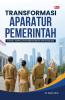
TRANSFORMASI APARATUR PEMERINTAH: Inovasi, Talenta, dan Kepemimpinan di Era Disrupsi
Keywords:
APARATUR PEMERINTAH, KEPEMIMPINANSynopsis
Perubahan lingkungan strategis yang berlangsung sangat cepat akibat revolusi teknologi digital, perkembangan kecerdasan buatan (artificial intelligence), globalisasi, perubahan sosial, krisis lingkungan, hingga ketidakpastian geopolitik telah mengubah cara pemerintah bekerja, mengambil keputusan, dan melayani masyarakat. Dalam situasi tersebut, aparatur pemerintah dituntut untuk mampu bertransformasi menjadi lebih adaptif, inovatif, profesional, dan responsif terhadap perubahan zaman.
Birokrasi konvensional yang selama ini identik dengan prosedur yang kaku, hierarki panjang, dan budaya administratif semata, semakin menghadapi tantangan besar dalam menjawab tuntutan masyarakat modern yang menghendaki pelayanan cepat, transparan, dan berbasis teknologi. Di sisi lain, perkembangan konsep agile government, smart governance, dan digital governance menunjukkan bahwa masa depan pemerintahan akan sangat ditentukan oleh kualitas sumber daya manusia aparatur, kemampuan inovasi organisasi, serta kapasitas kepemimpinan transformasional dalam mengelola perubahan yang kompleks. Oleh sebab itu, transformasi aparatur pemerintah bukan lagi sekadar pilihan kebijakan, melainkan sebuah keniscayaan yang harus dilakukan secara sistematis dan berkelanjutan.
Buku ini disusun untuk memberikan gambaran komprehensif mengenai transformasi aparatur pemerintah dalam berbagai dimensi strategis. Pada bagian awal, pembaca diajak memahami lanskap perubahan birokrasi modern, mulai dari urgensi transformasi aparatur, potret Aparatur Sipil Negara di Indonesia, paradigma baru birokrasi modern, hingga dampak era disrupsi terhadap sistem kerja dan kompetensi ASN. Pembahasan ini menjadi penting sebagai fondasi untuk memahami mengapa reformasi birokrasi harus terus dilakukan secara adaptif di tengah perubahan global yang sangat dinamis.
Buku ini juga membahas strategi implementasi transformasi aparatur pemerintah melalui pendekatan yang sistematis, mulai dari diagnosis organisasi, desain perubahan, implementasi kebijakan, hingga evaluasi transformasi birokrasi. Berbagai tantangan implementasi seperti resistensi perubahan, keterbatasan sumber daya, serta kompleksitas koordinasi pusat dan daerah turut menjadi perhatian utama. Dalam konteks otonomi daerah, transformasi aparatur pemerintah daerah juga menjadi isu strategis karena keberhasilan reformasi birokrasi nasional sangat ditentukan oleh kualitas tata kelola pemerintahan daerah. Kehadiran buku ini dapat menjadi salah satu kontribusi pemikiran dalam mendorong transformasi aparatur pemerintah yang lebih profesional, inovatif, adaptif, dan berorientasi pada pelayanan publik yang berkualitas demi terwujudnya tata kelola pemerintahan yang modern, berdaya saing, dan berkelanjutan.
Chapters
-
KATA PENGANTAR
-
DAFTAR ISI
-
DAFTAR TABEL
-
DAFTAR GAMBAR
-
BAGIAN 01 LANSKAP TRANSFORMASI APARATUR PEMERINTAH
-
BAGIAN 02 TRANSFORMASI TALENTA APARATUR
-
BAGIAN 03 INOVASI DALAM BIROKRASI PEMERINTAH
-
BAGIAN 04 KEPEMIMPINAN TRANSFORMASIONAL DALAM BIROKRASI
-
BAGIAN 05 IMPLEMENTASI DAN STRATEGI TRANSFORMASI
-
BAGIAN 06 REFLEKSI DAN MASA DEPAN APARATUR
-
DAFTAR PUSTAKA
-
PROFIL PENULIS
Downloads
References
Annafi, S., & Zendrato, S. A. (2025). Analisis implementasi sistem merit dalam rekrutmen dan promosi jabatan ASN dengan pendekatan SWOT terhadap tantangan dan strategi penguatan meritokrasi di Indonesia. Integrative Perspectives of Social and Science Journal, 2(2 Mei), 2867-2884.
Ansell, C., & Gash, A. (2008). Collaborative governance in theory and practice. Journal of Public Administration Research and Theory, 18(4), 543–571.
Ansell, C., & Trondal, J. (2018). Governance in turbulent times. Oxford: Oxford University Press.
Argyris, C., & Schön, D. A. (1996). Organizational learning II: Theory, method, and practice. Reading, MA: Addison-Wesley Publishing Company.
Armenakis, A. A., & Bedeian, A. G. (1999). Organizational change: A review of theory and research in the 1990s. Journal of management, 25(3), 293-315.
Badan Kepegawaian Negara (2026). Buku Statistik Aparatur Sipil Negara Per 31 Desember 2025.
Bannister, F., & Connolly, R. (2014). ICT, public values and transformative government: A framework and programme for research. Government Information Quarterly, 31(1), 119–128. https://doi.org/10.1016/j.giq.2013.06.002
Bardach, E. (2012). A practical guide for policy analysis: The eightfold path to more effective problem solving. Sage.
Becker, G. S. (1993). Human capital: A theoretical and empirical analysis, with special reference to education (3rd ed.). Chicago, IL: The University of Chicago Press.
Beck, K., Beedle, M., van Bennekum, A., Cockburn, A., Cunningham, W., Fowler, M., Grenning, J., Highsmith, J., Hunt, A., Jeffries, R., Kern, J., Marick, B., Martin, R. C., Mellor, S., Schwaber, K., Sutherland, J., & Thomas, D. (2001). Manifesto for Agile Software Development. Agile Alliance. Retrieved from https://agilemanifesto.org/.
Behn, R. D. (2008). The adoption of innovation: The challenge of learning to adapt tacit knowledge. Innovations in Government: Research, Recognition and Replication, 138-58.
Bennett, N., & Lemoine, G. J. (2014). What a difference a word makes: Understanding threats to performance in a VUCA world. Business horizons, 57(3), 311-317.
Boin, A., & ’t Hart, P. (2003). Public leadership in times of crisis: Mission impossible? Public Administration Review, 63(5), 544–553. https://doi.org/10.1111/1540-6210.00318
Borins, S. (2001). The challenge of innovating in government (pp. 356-408). Arlington, VA: PricewaterhouseCoopers Endowment for the Business of Government.
Bouckaert, G., & Halligan, J. (2008). Managing performance: International comparisons. London: Routledge Taylor & Francis Group.
Bozeman, B. (2000). Bureaucracy and Red Tape. Prentice Hall.
Brynjolfsson, E., & McAfee, A. (2014). The second machine age: Work progress and prosperity in a time of brilliant technologies. WW Norton & company.
Burnes, B. (2004). Managing change: A strategic approach to organisational dynamics (4th ed.). Harlow, England: Pearson Education Limited.
Castells, M. (2010). The rise of the network society (2nd ed.). Wiley-Blackwell.
Chapman, C., & Ward, S. (2003). Project risk management: Processes, techniques and insights. Wiley.
Chesbrough, H. (2003). Open innovation: The new imperative for creating and profiting from technology. Boston, MA: Harvard Business School Press.
Christensen, C. M. (1997). The innovator’s dilemma. Harvard Business School Press.
Clutterbuck, D. (2009). Coaching and mentoring in support of management development. The Sage handbook of management learning, education and development, 476-496.
Collings, D. G., & Mellahi, K. (2009). Strategic talent management: A review and research agenda. Human Resource Management Review, 19(4), 304–313. https://doi.org/10.1016/j.hrmr.2009.04.001
Cummings TG, & Worley CG (2009) Organization Development and Change. (9th Ed.), Mason, Ohio: South-Western Cengage Learning.
Davenport, T. H., & Harris, J. G. (2007). Competing on analytics: The new science of winning.
Davenport, T. H., & Ronanki, R. (2018). Artificial intelligence for the real world. Harvard Business Review, 96(1), 108–116.
Denhardt, J. V., & Denhardt, R. B. (2007). The new public service: Serving, not steering. M. E. Sharpe.
Denning, S. (2018). The age of agile: How smart companies are transforming the way work gets done. New York, NY: AMACOM.
Dolowitz, D. P., & Marsh, D. (2000). Learning from abroad: The role of policy transfer in contemporary policy‐making. Governance, 13(1), 5-24.
Dunleavy, P., Margetts, H., Bastow, S., & Tinkler, J. (2006). New public management is dead—long live digital-era governance. Journal of public administration research and theory, 16(3), 467-494.
Dweck, C. S. (2006). Mindset: The new psychology of success. New York, NY: Random House.
Emerson, K., Nabatchi, T., & Balogh, S. (2012). An integrative framework for collaborative governance. Journal of Public Administration Research and Theory, 22(1), 1–29.
Florida, R. (2002). The rise of the creative class.
Floridi, L., Cowls, J., Beltrametti, M., Chatila, R., Chazerand, P., Dignum, V., Luetge, C., Madelin, R., Pagallo, U., Rossi, F., Schafer, B., Valcke, P., & Vayena, E. (2018). AI4People—An ethical framework for a good AI society: Opportunities, risks, principles, and recommendations. Minds and Machines, 28(4), 689–707.
Folke, C., Hahn, T., Olsson, P., & Norberg, J. (2005). Adaptive governance of social-ecological systems. Annual Review of Environment and Resources, 30, 441–473. https://doi.org/10.1146/annurev.energy.30.050504.144511
Ford, J. D., Ford, L. W., & D’Amelio, A. (2008). Resistance to change. Academy of Management Review, 33(2), 362–377.
Freidson, E. (2001). Professionalism: The third logic. Chicago, IL: The University of Chicago Press.
Fukuyama, M. (2018). Society 5.0: Aiming for a new human-centered society. Japan Spotlight, 27(5), 47–50.
Fung, A. (2006). Varieties of participation in complex governance. Public Administration Review, 66(s1), 66–75.
Garavan, T. N., Morley, M., Gunnigle, P., & Collins, E. (2001). Human capital accumulation. Journal of European Industrial Training, 25(2–4), 48–68.
Goleman, D. (1998). Working with emotional intelligence. Bantam Books.
Grant, A. M. (2014). The efficacy of executive coaching in times of organisational change. Journal of Change Management, 14(2), 258–280.
Grindle, M. S. (2007). Going local: Decentralization, democratization, and the promise of good governance. Princeton University Press.
Grindle, M. S. (2004). Good enough governance: Poverty reduction and reform in developing countries. Governance, 17(4), 525–548. https://doi.org/10.1111/j.0952-1895.2004.00256.x.
Grindle, M. S. (2012). Jobs for the boys: Patronage and the state in comparative perspective. Cambridge, MA: Harvard University Press.
Head, B. W. (2016). Toward more “evidence-informed” policy making? Public Administration Review, 76(3), 472–484. https://doi.org/10.1111/puar.12475.
Heifetz, R. A., Grashow, A., & Linsky, M. (2009). The practice of adaptive leadership: Tools and tactics for changing your organization and the world. Boston, MA: Harvard Business Press.
Held, D. (2010). Cosmopolitanism: Ideals and realities. Polity.
Hillson, D. (2002). Effective opportunity management for projects: Exploiting positive risk..
Hitachi-UTokyo Laboratory. (2019). Society 5.0: A people-centric super-smart society. Singapore: Springer Open. https://doi.org/10.1007/978-981-15-2989-4.
Hodge, G., & Greve, C. (2007). Public–private partnerships. Public Administration Review, 67(3), 545–558.
Hood, C. (1991). A public management for all seasons?. Public administration, 69(1), 3-19.
Hopkin, P. (2018). Fundamentals of risk management: understanding, evaluating and implementing effective risk management. Kogan Page Publishers.
Huberts, L. (2018). Integrity: What it is and why it is important. Palgrave Macmillan.
Iksan (2020). Mengintip Pelayanan Administrasi Kependudukan di Tengah Wabah COVID-19. Birokrat Menulis.
Iksan (2025). Membangun Organizational Innovation Power Dalam Meningkatkan Organizational Performance. Disertasi.
Iksan (2026). Membongkar Tender Pemerintah: Strategi, Risiko, dan Integritas Publik. Penerbit Adab.
Iksan (2026). Transformasi Perencanaan Pembangunan Daerah: Sistem, Tantangan, dan Strategi Menuju Pembangunan Berkelanjutan. Penerbit Karya Bakti Makmur (KBM) Indonesia.
Iksan, I., Sirat, A. H., Hidayanti, I. & Jannang, A. R., (2025). The Effect of Organizational Capability and Tacit Knowledge on Organizational Performance: A Case Study on Organizational Innovation Power as Mediation in the Indonesian Public Sector. Australasian Accounting, Business and Finance Journal 19(3): 14, 303–325.
Janssen, M., Charalabidis, Y., & Zuiderwijk, A. (2012). Benefits, adoption barriers and myths of open data and open government. Information systems management, 29(4), 258-268.
Janssen, M., & Van den Hoven, J. (2015). Big and open linked data (BOLD) in government: A challenge to transparency and privacy? Government Information Quarterly, 32(4), 363–368. https://doi.org/10.1016/j.giq.2015.11.007.
Joiner, B., & Josephs, S. (2007). Leadership agility: Five levels of mastery for anticipating and initiating change. Jossey-Bass.
Kaplan, R. S., & Norton, D. P. (2004). The strategy map: guide to aligning intangible assets. Strategy & leadership, 32(5), 10-17.
Kementerian PANRB. 2022. Capaian Strategis Kementerian PANRB Tahun 2022. Jakarta.
Keohane, R. O., & Nye, J. S. (2000). Power and interdependence. Longman.
Kitchin, R. (2014). The data revolution: Big data, open data, data infrastructures and their consequences. Sage.
Kolb, D. A. (1984). Experiential learning: Experience as the source of learning and development. Prentice Hall.
Kotler, P., & Keller, K. L. (2016). Marketing management (15th ed.). Harlow, England: Pearson Education Limited.
Kotter, J. P. (1996). Leading change. Harvard Business School Press.
Kotter, J. P., & Schlesinger, L. A. (1979). Choosing strategies for change. Harvard Business Review.
Kram, K. E. (1988). Mentoring at work: Developmental relationships in organizational life. University Press of America.
Leoni, G., & Parker, L. D. (2019). Governance and control of sharing economy platforms: Hosting on Airbnb. The British Accounting Review, 51(6), 100814.
Lewis, R. E., & Heckman, R. J. (2006). Talent management: A critical review. Human Resource Management Review, 16(2), 139–154. https://doi.org/10.1016/j.hrmr.2006.03.001.
March, J. G. (1994). A primer on decision making: How decisions happen. New York, NY: The Free Press.
Margetts, H., & Dunleavy, P. (2013). The second wave of digital-era governance. Philosophical Transactions of the Royal Society A.
Mayer-Schönberger, V., & Cukier, K. (2013). Big data: A revolution that will transform how we live, work, and think. London: John Murray Publishers.
Meijer, A., & Bolívar, M. P. R. (2016). Governing the smart city: a review of the literature on smart urban governance. International review of administrative sciences, 82(2), 392-408.
Mergel, I., Edelmann, N., & Haug, N. (2019). Defining digital transformation in the public sector. Government Information Quarterly, 36(4), 1–11.
Mergel, I., Gong, Y., & Bertot, J. C. (2018). Agile government: Systematic literature review and future research. Government Information Quarterly, 35(2), 291–298. https://doi.org/10.1016/j.giq.2018.04.003.
Merton, R. K. (1968). Social theory and social structure. Simon and Schuster. New York: Free Press.
Michaels, E., Handfield-Jones, H., & Axelrod, B. (2001). The war for talent. Boston, MA: Harvard Business School Press.
Mintzberg, H. (2009). Managing. San Francisco, CA: Berrett-Koehler Publishers.
Moore, M. H. (2013). Recognizing public value. Harvard University Press.
Moynihan, D. P. (2008). The Dynamics of Performance Management: Constructing Information and Reform. Washington, DC: Georgetown University Press.
Mulgan, G., & Albury, D. (2003). Innovation in the public sector. London: Strategy Unit.
Nam, T., & Pardo, T. A. (2011). Conceptualizing smart city with dimensions of technology, people, and institutions. In Proceedings of the 12th Annual International Digital Government Research Conference: Digital Government Innovation in Challenging Times (pp. 282–291). New York, NY: ACM Press. https://doi.org/10.1145/2037556.2037602
Nanus, B. (1992). Visionary leadership: Creating a compelling sense of direction for your organization. San Francisco, CA: Jossey-Bass Publishers.
Noe, R. A. (2010). Employee training and development (5th ed.). New York, NY: McGraw-Hill/Irwin.
Northouse, P. G. (2018). Leadership: Theory and practice. Sage.
Organisation for Economic Co-operation and Development (OECD). (2017). Government at a glance. OECD Publishing.
Organisation for Economic Co-operation and Development (OECD). (2016). Open Government in Indonesia, OECD Public Governance Reviews, OECD Publishing, Paris. http://dx.doi.org/10.1787/
Organisation for Economic Co-operation and Development (OECD). (2020). Development Co-operation Report 2020: Learning from Crises, Building Resilience, OECD Publishing, Paris, https://doi.org/10.1787/f6d42aa5-en.
Organisation for Economic Co-operation and Development (OECD). (2019). Going Digital: Shaping Policies, Improving Lives. Paris: OECD Publishing.
Organisation for Economic Co-operation and Development (OECD). (2020). Digital government index. OECD Publishing.
Organisation for Economic Co-operation and Development (OECD). (2021). The digital transformation of the public sector. OECD Publishing.
Osborne, D. (2007). Reinventing government: What a difference a strategy makes. In 7th global forum on reinventing government: Building trust in government (pp. 26-29).
Osborne, S. P. (2010). The new public governance? Routledge.
Osborne, S. P., & Brown, L. (2011). Innovation in public services. Routledge.
Parlina, R., Wijatmoko, S., & Syafutra, R. (2023). Pengembangan Sumber Daya Manusia Sektor Publik Menuju Birokrasi Modern. Musamus Journal of Public Administration, 6(1), 488-494.
Patton, M. Q. (2008). Utilization-focused evaluation. Sage publications.
Pollitt, C., & Bouckaert, G. (2017). Public management reform. Oxford University Press.
Porter, M. E. (1990). The competitive advantage of nations. New York, NY: The Free Press.
Prahalad, C. K., & Ramaswamy, V. (2004). The future of competition: Co-creating unique value with customers. Boston, MA: Harvard Business School Press.
Pressman, J., & Wildavsky, A. (1973). Implementation. University of California Press.
Provost, F., & Fawcett, T. (2013). Data Science for Business: What you need to know about data mining and data-analytic thinking. O'Reilly Media, Inc.
Rittel, H. W., & Webber, M. M. (1973). "Dilemmas in a General Theory of Planning.".
Robbins, S. P., & Judge, T. A. (2017). Organizational Behavior (14th ed.). Pearson Education.
Robinson, M, & Last, D. (2009). A Basic Model of Performance-Based Budgeting. Washington, DC: International Monetary Fund (IMF). IMF Technical Notes and Manuals, TNM/09/01.
Rogers, E. M. (2003). Diffusion of innovations (5th ed.). New York, NY: Free Press.
Rondinelli, D. A. (1981). Government decentralization in comparative perspective: theory and practice in developing countries. International review of administrative sciences, 47(2), 133-145.
Rose-Ackerman, S. (1999). Corruption and government: Causes, consequences, and reform. Cambridge: Cambridge University Press.
Rosenau, J. N., & Czempiel, E. O. (Eds.). (1992). Governance without government: order and change in world politics (No. 20). Cambridge University Press.
Rothwell, W. J. (2010). Effective succession planning: Ensuring leadership continuity and building talent from within. AMACOM.
Russell, S. J., & Norvig, P. (2016). Artificial intelligence: A modern approach (3rd ed.). Harlow, England: Pearson Education Limited.
Schein, E. H. (2010). Organizational culture and leadership (4th ed.). San Francisco, CA: Jossey-Bass.
Schön, D. A. (1984). The architectural studio as an exemplar of education for reflection-in-action. Journal of architectural education, 38(1), 2-9.
Schultz, T. W. (1961). Investment in human capital. The American Economic Review, 51(1), 1–17.
Schwab, K. (2016). The Fourth Industrial Revolution.
Senge, P. M. (1990). The fifth discipline: The art and practice of the learning organization. Doubleday.
Tapscott, D. (2009). Grown up digital: How the net generation is changing your world. New York: McGraw-Hill.
Transparency International (2022). Indonesia’s Corruption Perception Index 2022 Experiences The Worst Decline In The History Of The Reform Era.
United Nations Educational, Scientific and Cultural Organization. (UNESCO). (2021). Future of learning and leadership development in public sector. UNESCO Publishing.
United Nations Department of Economic and Social Affairs (UNDESA). (2020). Digital government in the decade of action. United Nations Department of Economic and Social Affairs.
United Nations Department of Economic and Social Affairs. (UNDESA). (2018). World public sector report 2018: Working together — Integration, institutions and the sustainable development goals. New York, NY: United Nations.
United Nations Department of Economic and Social Affairs (UNDESA). (2020). Digital government in the decade of action for Sustainable Development. United Nations.
United Nations Development Programme. (2021). UNDP COVID-19 Adaptation and Response. New York: United Nations Development Programme.
Van der Heijden, K. (2005). Scenarios: the art of strategic conversation. John Wiley & Sons.
Van Dijk, J. (2020). The digital divide. John Wiley & Sons.
Van Thiel, S., & Leeuw, F. L. (2002). The performance paradox in the public sector. Public Performance & Management Review, 25(3), 267–281.
Walker, W. E., Lempert, R. J., & Kwakkel, J. H. (2013). Deep uncertainty. In S. I. Gass & M. C. Fu (Eds.), Encyclopedia of operations research and management science (pp. 395–402). Boston, MA: Springer. https://doi.org/10.1007/978-1-4419-1153-7_1140.
Weber, M. (1947). The theory of social and economic organization. Free Press.
Weber, M. (1978). Economy and society: An outline of interpretive sociology (Vol. 2). University of California press.
Weiss, T. G. (2013). Global governance: Why? what? whither?. Polity Press.
Weiss, T. G., & Wilkinson, R. (2018). International organization and global governance. Routledge.
Whitmore, J. (2009). Coaching for performance: Growing human potential and purpose. Nicholas Brealey Publishing.
Wilson, W. (1887). The study of administration. Political Science Quarterly, 2(2), 197–222. https://doi.org/10.2307/2139277
Wirtz, B. W., Weyerer, J. C., & Geyer, C. (2019). Artificial intelligence in public administration. International Journal of Public Administration, 42(7), 596–615.
World Bank. (1992). Governance and development. Washington, DC: The World Bank.
World Bank. (2012). Public sector management and governance. World Bank.
World Bank. (2020). World development report: Digital dividends. World Bank.
World Economic Forum. (2020). The future of jobs report 2020. Geneva: World Economic Forum.
Yin, R. K. (2014). Case study research: Design and methods (5th ed.). Thousand Oaks, CA: Sage Publications.
Published
License

This work is licensed under a Creative Commons Attribution-ShareAlike 4.0 International License.